Note on romanisation: Chinese names are given in pinyin, with the original characters in parentheses on first occurrence. Tones are not graphically marked, in line with current editorial usage.
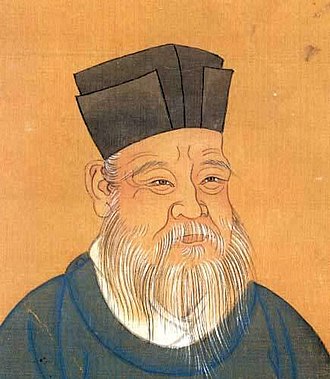
Zhu Xi (朱熹), a Southern Song philosopher, is the great systematiser of what is conventionally called Neo-Confucianism — also known as Lixue (理學, “Learning of Principle”) or the Cheng-Zhu school, after the Cheng brothers (Cheng Hao and Cheng Yi), whose writings Zhu Xi organised into a synthesis. A government official and teacher, he spent most of his life lecturing at private academies and revising the classical texts. His historical importance is hard to overstate: the educational curriculum grounded on his commentaries to the Sishu (四書, “Four Books”) was the basis of the Chinese imperial examinations from 1313 to 1905, and through that channel it also shaped the thought of Korea, Vietnam and Japan.
Zhu Xi did not see himself as an innovator but as a faithful continuator of the way of the ancient sages. The label “rationalist,” sometimes applied to his school, is misleading if taken in its modern European sense: li (理) is not “reason” in a Cartesian sense, but the intelligible pattern immanent in things — a notion that does not oppose thought and nature in the terms of Western modernity.
Key Concepts
Li (理, “principle” or “pattern”): the constitutive pattern of each thing and of the cosmos as a whole. Each being has its particular li, but there is a single supreme li (identified with the taiji) of which the particular principles are specifications. It is neither efficient cause nor substance, but intelligible norm.
Qi (氣, “energy/matter”): the dynamic, differentiating substrate of which individual things are made. Qi varies in purity and turbidity, and accounts for particularity, embodiment, and moral differences between individuals. Li without qi would be empty; qi without li would be chaos.
Taiji (太極, “Supreme Polarity”): the ultimate principle, taken over by Zhu Xi from Zhou Dunyi’s Taijitu shuo. It is not a first entity alongside others, but li at its highest generality — “the li of Heaven, Earth and the ten thousand beings.”
Gewu zhizhi (格物致知, “investigation of things and extension of knowledge”): an expression drawn from the Great Learning and elevated by Zhu Xi into an ethical-cognitive method. To know things in their li is the first step of self-cultivation; the interpretation of this formula is the point of the famous dispute with Wang Yangming, who reads it in an opposite, introspective key.
Self-cultivation (xiushen, 修身) and inner reverence (jing, 敬): ethical cultivation has two dimensions — study of the classics and investigation of things, on the one hand, and the focused attention of the heart-mind (xin, 心) on the other. Jing is the inner stance of the Confucian scholar.
Original goodness of human nature: Zhu Xi takes up Mencius’s thesis that human nature (xing, 性) is good, and explains evil by the turbidity of particular qi, which obscures the manifestation of li. Moral practice is thus clarification, not creation.
Influenced by
- The Cheng brothers — Cheng Hao (1032–1085) and Cheng Yi (1033–1107), the direct precursors of Lixue whose work Zhu Xi systematises
- Zhou Dunyi (1017–1073) — author of the Taijitu shuo (“Explanation of the Diagram of the Supreme Polarity”)
- Zhang Zai (1020–1077) — thinker of qi and author of the Ximing (“Western Inscription”)
- Confucius and Mencius — the founding canon, which Zhu Xi reorganises by elevating the Sishu above the Wujing (“Five Classics”)
Influenced
- Chinese imperial curriculum — Zhu Xi’s commentaries on the Four Books were the basis of the examinations from 1313 (Yuan dynasty) to 1905 (the end of the Qing)
- Korean (Joseon) and Vietnamese thought — “Cheng-Zhu” became de facto state orthodoxy
- Japanese Neo-Confucianism (Edo period) — Hayashi Razan and Yamazaki Ansai, among others
- Wang Yangming (1472–1529) — as an internal critic: he rejects the reading of gewu as external investigation, proposing instead the “unity of knowing and acting”
- The Goose Lake meeting (1175) — celebrated debate with Lu Jiuyuan over the method of study and the primacy of the heart-mind
Works
Zhu Xi’s most widely diffused and enduring work is the Sishu Zhangju Jizhu (四書章句集注, “Collected Commentaries on the Four Books in Chapters and Sentences”), his commentary on the Four Books — Daxue (Great Learning), Zhongyong (Doctrine of the Mean), Lunyu (Analects) and Mencius — which he himself raised to canonical status. He also compiled the Jinsi lu (近思錄, “Reflections on Things at Hand,” c. 1175), a thematic anthology of texts by Zhou Dunyi, Zhang Zai and the Cheng brothers, in collaboration with Lü Zuqian; and the Zhuzi Yulei (朱子語類, “Classified Conversations of Master Zhu”), the vast posthumous collection of his dialogues with disciples.
See also
Confucio; Wang Yangming; Mencio