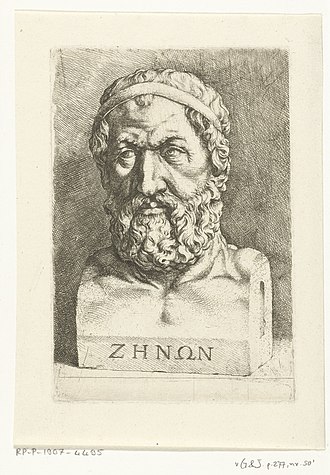
Born in Elea, in southern Italy, and active in the mid-fifth century BCE, Zeno was the most celebrated disciple of Parmenides — according to Plato, he accompanied his master to Athens, where the two are said to have conversed with the young Socrates. Tradition also attributes to him a heroic end: tortured by a tyrant whose overthrow he was plotting, he is said to have preferred death to betrayal. He is remembered above all as a master of argument.
His aim was to defend the theses of Parmenides — being is one and immobile — not by proving them directly, but by showing that the contrary positions lead to absurdity. To this end he devised some forty paradoxes, of which a few extremely famous ones survive, directed against the reality of motion and of multiplicity. For this strategy, Aristotle hailed him as the inventor of dialectic.
The best known attack motion. In the paradox of Achilles and the tortoise, the swift hero could never catch the slow tortoise given a head start, for he would always first have to cover the distance it had already covered, ad infinitum. There is also the dichotomy paradox: to traverse any distance, one must first traverse its half, and before that the half of the half, and so on indefinitely — so that motion could never even begin. In the paradox of the arrow, it would be at rest at every instant of its flight — hence motion would be illusory. Far from mere games, these arguments touch on deep problems about the infinite, the continuum, and the divisibility of space and time; only with the calculus and the modern theory of limits would mathematics offer satisfactory answers to several of them, and they are still discussed today in the philosophy of mathematics and physics.
Key concepts
- Paradox of Achilles and the tortoise: Achilles never catches the tortoise because the distance is infinitely divisible
- Paradox of the arrow: at each instant the arrow is at rest → motion is illusory
- Reductio ad absurdum as a philosophical method
Influenced by
- Parmenides (master)
Influenced
- Aristotle — study of the continuum and the infinite (Physics, VI)
- Contemporary analytic philosophy — Zeno’s paradoxes still discussed in philosophy of mathematics
Works
Fragments in Simplicius; accounts in Aristotle, Physics VI, 9; Plato, Parmenides.
See also
Pre-Socratics and Sophists