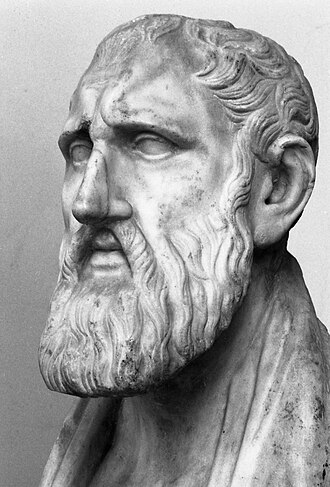
Founder of Stoicism. He taught at the Stoa Poikilê (Painted Porch) in Athens — hence the name of the school. After hearing the story of Socrates through the cynicism of Crates, he abandoned commerce to dedicate himself to philosophy. He taught that virtue is the only real good; everything else (wealth, health, fame) is indifferent (adiaphora). The universe is permeated by the divine Logos (rational fire) and each event occurs by rational necessity.
Born in Citium, a Greek colonial city on the island of Cyprus, Zeno was of Phoenician descent and arrived in Athens around 312 B.C.E., initially as a merchant. Tradition holds that, after a shipwreck or during a stay in the city, he read Xenophon’s Memorabilia and was so struck by the figure of Socrates that he asked where he could find men like him; he was directed to the Cynic Crates of Thebes, his first teacher. He later studied with the Megarian philosopher Stilpo and attended the Platonic Academy, absorbing diverse influences before opening his own school.
The philosophy Zeno systematized is divided into three interconnected parts: logic (theory of knowledge and language), physics (cosmology and theology), and ethics (the correct way to live). Stoic logic introduced the notion of the phantasia katalêptikê — the impression that grasps reality as it truly is — as the foundation of reliable knowledge. In physics, the universe is a living rational being permeated by the Logos-fire that the Stoics identified with divine providence. From physics, ethics follows: because reason governs the cosmos, living according to nature means living according to reason, an ideal Zeno formulated with precision that would become the axis of all subsequent Stoic ethics. His influence spanned centuries: the Roman Stoics Seneca, Epictetus, and Marcus Aurelius took up and popularized his teachings, and the cosmopolitanism he championed — the idea that all human beings share a common reason and belong to a single moral community — continues to echo in modern political thought and in the philosophical foundations of human rights.
Key Concepts
- Virtue as the only good; indifferents (adiaphora)
- Cosmos permeated by Logos/rational fire
- Living according to nature = living according to reason
- Cosmopolitanism: all humans are citizens of the world
- Cataleptic impression (phantasia katalêptikê) as criterion of truth
Influenced by
- Diogenes of Sinope / Crates (Cynicism)
- Heraclitus — Logos and cosmic fire
- Plato and Aristotle — via readings at the Academy
Influenced
- Cleanthes of Assos — immediate successor
- Chrysippus of Soli — systematizer of Stoicism
- Seneca, Epictetus, Marcus Aurelius — Roman Stoicism
- Christian tradition — providence, cosmopolitanism
Works
None preserved. Sources: Diogenes Laertius, Lives, VII.
See also
Hellenistic Philosophy