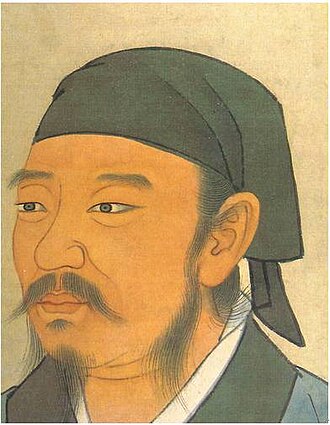
Xunzi (荀子 Xún Zǐ, “Master Xun”; personal name Kuàng 況), who lived around c. 310–c. 235 BCE, is, alongside Confucius and Mencius, one of the three great thinkers of classical Confucianism. He was active during the Warring States period and was a figure of prestige at the Jixia Academy in the state of Qi. His philosophy stands out for its argumentative rigour and its naturalism: whereas other Confucians grounded morality in a morally engaged celestial order, Xunzi grounds it in human culture, ritual, and deliberate education.
His most famous thesis — that human nature is originally deviant — places him in direct opposition to Mencius and made him one of the most debated voices of the tradition. Unlike other classics, which were largely compiled by disciples, the work bearing his name consists mostly of systematic essays of his own authorship.
Key Concepts
Human nature is deviant (xìng è 性惡): the central thesis, in explicit contrast with Mencius’s doctrine of innate goodness (xìng shàn). For Xunzi, the spontaneous inclinations of human beings — appetites, greed, envy — lead to conflict if left uncorrected. Goodness is not given by nature but is an achievement (wěi 偽, “artifice” or “deliberate effort”) of culture and moral labour.
Ritual (lǐ 禮): if nature is raw, it is ritual that refines it. Lǐ — the body of norms, ceremonies, and forms of civilized conduct — is the great invention of the ancient sages for channelling desire, ordering society, and shaping character. Ritual is not mere etiquette but the chief instrument of moral transformation.
Music and education as moral formation: alongside ritual, Xunzi assigns a decisive formative role to music (yuè 樂) and education. Well-ordered music harmonizes the emotions and cultivates the feelings; learning is a continuous process of accumulation that transforms the raw individual into a cultivated person.
Rectification of names (zhèngmíng 正名): a concern with the correspondence between words and realities. Names are conventions established by legitimate authority to order thought and communication; the confusion of names breeds social and intellectual disorder, and their correct use must be restored.
Naturalism about Heaven (tiān 天): against the conception of a morally interventionist Heaven, Xunzi understands Heaven as regular, impersonal nature, which follows its own constant courses without rewarding or punishing humanity. The task of the human being is not to implore Heaven but to know and make use of its patterns. This “demoralization” of Heaven is one of the most distinctive positions of his thought.
Accumulation and effort (jī 積): virtue results from constant and accumulated practice. No one is born wise; one becomes wise by persisting in study and moral exercise. The metaphor of learning as a process of continual polishing recurs throughout his work.
Influenced by
- Confucius — the inheritance of virtue ethics and the centrality of ritual (lǐ)
- Debate with Mencius — his doctrine is constructed in express opposition to the thesis of innate goodness
- Traditions of the Jixia Academy — a plural debating environment (Confucians, Daoists, Mohists) in the state of Qi
Influenced
- Han Feizi — his disciple, the chief systematizer of Legalism
- Li Si — also associated with him, the chief minister who helped unify the Qin empire under Legalist principles
- The later Confucian tradition — though long eclipsed by Mencius within orthodoxy, he was recovered for his rigorous defence of ritual
- Political philosophy and theories of cultural formation — comparative readings with the idea that institutions “civilize” human nature
Works
The Xunzi (荀子) is a collection of thematic essays that, unlike classics such as the Analects (compiled by disciples from scattered sayings), presents systematic and continuous argumentation, attributed largely to the author himself. It includes famous chapters such as “Encouraging Learning” (Quànxué 勸學), “Discourse on Heaven” (Tiānlùn 天論), “Human Nature Is Deviant” (Xìng’è 性惡), and “Discourse on Ritual” (Lǐlùn 禮論). Even so, as with any ancient text transmitted by copying, there is philological debate over the authenticity of individual chapters and over later interpolations.
See also
Eastern Philosophy; Mencius; Confucius