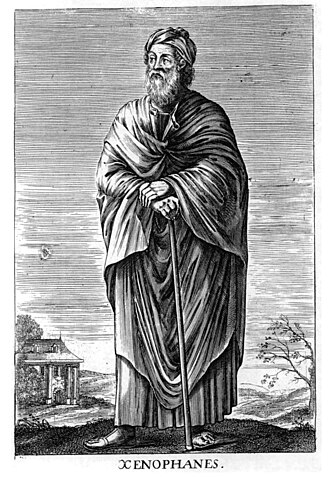
Itinerant Greek poet-philosopher, born in Colophon, in Ionia (the western coast of Asia Minor), around 570 BCE. When the Persian conquest of Ionia began in the mid-sixth century BCE, Xenophanes left his native city and spent the rest of his life wandering the Greek world, residing for periods in Zancle and Catana in Sicily and, according to tradition, in Elea in southern Italy. He lived to an exceptionally advanced age — ancient sources suggest he surpassed ninety years — and his entire output survives only in fragments preserved by later authors such as Sextus Empiricus, Simplicius, and Athenaeus.
His philosophical starting point was a radical critique of the religious tradition inherited from Homer and Hesiod. Observing that each people projects its own physical and moral traits onto its gods, Xenophanes concluded that anthropomorphism reveals nothing about the nature of the divine — only the workings of human imagination. Against this, he proposed the existence of a single, eternal, and motionless God who governs the universe through pure thought alone, without moving or acting with effort. This divinity possesses no human form and no passions; it is utterly unlike the Olympian gods, and in this sense Xenophanes inaugurates in Western philosophy a rational theology that separates the divine from popular representation.
Alongside his theology, Xenophanes developed a pioneering epistemological stance: he recognized that human knowledge is always partial and provisional. Even if someone were to state the truth about the cosmos, there would be no way to verify with certainty that he had done so — a distinction between opinion and knowledge that anticipates central debates in ancient skepticism and, later, in modern epistemology. His observations about marine fossils found on mountains constitute one of the earliest records of empirical geological reasoning in the history of Western philosophy. Xenophanes’ influence on Parmenides and, through him, on the entire Eleatic tradition was acknowledged already in antiquity, securing his place as one of the great inaugurators of Greek rational thought.
Traveled throughout the Greek world for decades singing his philosophical verses. Considered a precursor to the Eleatic School (influenced Parmenides). Notable for his critique of anthropomorphic religion and proto-epistemological observations.
Key Concepts
- Critique of religious anthropomorphism: Homer and Hesiod attributed human crimes to the gods (theft, adultery, betrayal); the Ethiopians make their gods black and flat-nosed, the Thracians make theirs red-haired and blue-eyed — if oxen and horses could paint gods, they would make them bovine and equine
- Philosophical monotheism: there is a single God, the greatest among gods and men, who resembles mortals in nothing — neither in body nor in thought; immobile, he governs all things by his thought
- Epistemology of moderate skepticism: the gods did not reveal everything to men from the beginning; mortals discover the best progressively — but no man attains total truth about the gods and the cosmos; even if one spoke the truth, one could not be certain
- Geology and fossils: found marine fossils on mountains and concluded that earth and sea alternate; used empirical observations to speculate about cosmic changes
Influenced by
- Milesian School — naturalism and critique of myth
- Greek poetic tradition — uses philosophical hexameters and elegies
Influenced
- Parmenides — monism and concept of the One
- Ancient Skepticism (through epistemological humility)
- Plato — critique of the representation of gods in Homer (Republic)
Works
Fragments in verse (elegies, silloi, didactic poem On Nature) preserved through citations by other authors.
See also
Pre-Socratics and Sophists