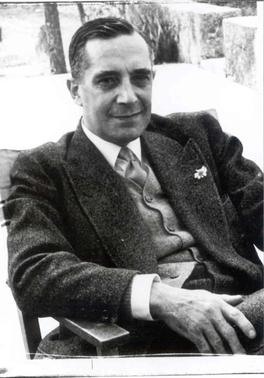
Xavier Zubiri Apalategui was born in San Sebastián on 4 December 1898 and died in Madrid on 21 September 1983. Trained in philosophy and theology in Madrid, Leuven and Rome, he was ordained a priest and, in 1926, won by competitive examination the chair of History of Philosophy at the Universidad Central in Madrid, where he was a disciple of Ortega y Gasset and Manuel García Morente. In 1929–1930 he studied at Freiburg with Husserl and Heidegger, and then in Berlin, where he also devoted himself to physics, philology and biology. He left the clerical state in the 1930s and married Carmen Castro, daughter of the historian Américo Castro. After the Civil War, much of his work was presented in private courses and lectures, and only in the last decades of his life did it take the form of books.
His work seeks a first philosophy that is neither idealism nor mere phenomenology, and rejects what he calls the logification of intelligence (reducing understanding to judging and to “being”) and the entification of reality (reducing reality to “entity”), tendencies he attributes to a long tradition of Western philosophy, which on this point includes Heidegger himself. For Zubiri the primary category is not being but reality, understood as “formality”: the way things are present in apprehension as being “de suyo” (“of their own”), that is, with a content that belongs to them prior to the act of apprehending them.
In Sobre la esencia (1962) he sets out a theory of essence as a structure of “notes” forming systems (substantivity) and of reality as “respectivity” among things. In the trilogy Inteligencia sentiente (Inteligencia y realidad, 1980; Inteligencia y logos, 1982; Inteligencia y razón, 1983) he argues that sensing and understanding are not two juxtaposed faculties but two moments of a single act: the primordial apprehension of reality, from which logos and reason unfold as forms of intelligence. In Naturaleza, Historia, Dios (1944) and in posthumous texts such as El hombre y Dios (1984), he develops the idea of religation (religación): in carrying out his life the human person finds himself bound to the “power of the real,” the dimension in which Zubiri locates the problem of God, without starting from traditional demonstrative proofs.
Key Concepts
- Sentient intelligence — the unity of sensing and understanding in a single act of apprehension (Inteligencia sentiente, 1980–1983).
- Primordial apprehension of reality — the primary, irreducible mode in which reality is present, prior to judgment.
- Formality of reality / “de suyo” — reality as a mode of otherness in which what is apprehended is “of its own.”
- Substantivity — the system of notes that constitutes the reality of a thing (Sobre la esencia, 1962).
- Religation — the human being’s binding to the power of the real, the basis of the problem of God.
- Logification of intelligence and entification of reality — critiques of a tradition that subordinates intelligence to judgment and reality to being.
Influenced by
- José Ortega y Gasset — his teacher in Madrid, from whom he moved away as he developed a system of his own
- Husserl — phenomenological method and the analysis of apprehension
- Heidegger — direct interlocutor, from whom he differs in prioritizing “reality” over “being”
- Aristotle and Thomas Aquinas — the metaphysical tradition he discusses critically
- The sciences of his day (physics, biology), which he followed in Berlin
Influenced
- Ignacio Ellacuría — philosopher and theologian who developed Zubirian philosophy in Central America
- Diego Gracia, Antonio Pintor-Ramos and other Spanish-language scholars
- Studies in the philosophy of religion and metaphysics in the Hispanic tradition
Works
Naturaleza, Historia, Dios (1944); Sobre la esencia (On Essence, 1962); Cinco lecciones de filosofía (1963); Inteligencia sentiente: Inteligencia y realidad (1980), Inteligencia y logos (1982), Inteligencia y razón (1983); posthumous: El hombre y Dios (1984), Sobre el hombre (1986), Estructura dinámica de la realidad (1989).