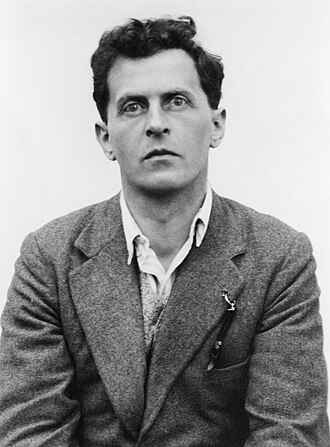
Born in Vienna in 1889, into one of the wealthiest and most cultured families of the Austro-Hungarian Empire, Ludwig Wittgenstein began by studying aeronautical engineering, but reflection on the foundations of mathematics led him to logic and from there to Cambridge, to study with Bertrand Russell. His biography is as singular as his thought: he fought in the First World War, gave away his inherited fortune, worked as a village schoolteacher, a gardener, and even an architect, before returning to academic philosophy. He is the most influential figure in twentieth-century analytic philosophy — and, very rarely, the author of two distinct and equally decisive philosophies, both centered on language.
The early Wittgenstein, of the Tractatus Logico-Philosophicus (1921), conceives of language as a logical picturing of the world: meaningful propositions are those that depict possible facts. What lies beyond that limit — ethics, aesthetics, metaphysics — cannot be said, only shown. Hence the famous closing sentence: “whereof one cannot speak, thereof one must be silent.”
The later Wittgenstein, of the Philosophical Investigations (published posthumously in 1953), radically revises the first work. The meaning of a word is not the object it names but its use within a practice — a language game rooted in a “form of life.” There is no “private language,” and to follow a rule is always a public practice. Philosophy, he concludes, discovers no theories: it dissolves the confusions born of the misfiring of language, functioning rather as a kind of therapy. His impact ran through the logical positivism of the Vienna Circle, ordinary-language philosophy, and contemporary philosophy of mind.
Key Concepts
Early Wittgenstein — Tractatus Logico-Philosophicus (1921)
- Language pictures facts of the world; propositions are logical pictures of reality
- What can be said can be said clearly; what cannot be said must be passed over in silence (“Whereof one cannot speak, thereof one must be silent”)
- Logic and mathematics are tautologies; ethics, aesthetics, and metaphysics are ineffable
Later Wittgenstein — Philosophical Investigations (posthumous, 1953)
- Language games: meaning is not reference to objects, but use in social practice; each form of life has its own games
- Following a rule: impossible to follow a rule “privately”; rules are public and intersubjective practices
- Private language (impossibility): there is no language whose terms refer only to internal experiences inaccessible to others
- Philosophy as therapy: philosophical problems are linguistic confusions to be dissolved, not solved
Influenced by
- Gottlob Frege — logic and reference
- Bertrand Russell — logical atomism (Tractatus)
- Kant — limits of knowledge (reinterpreted)
Influenced
- Vienna Circle (logical positivism — misinterpreted the Tractatus)
- Habermas — language and intersubjectivity
- Gilbert Ryle, J.L. Austin — ordinary language philosophy
- Contemporary philosophy of mind
Works
Tractatus Logico-Philosophicus (1921); Philosophical Investigations (1953, posthumous); On Certainty (1969, posthumous); The Blue and Brown Books (1958).
See also
Twentieth-Century Philosophy