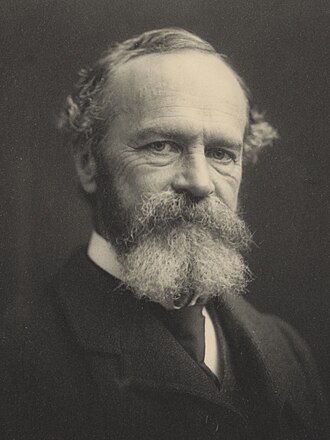
American philosopher and psychologist, co-founder of pragmatism and pioneer of modern psychology. Brother of novelist Henry James. He popularized and developed Peirce’s pragmatism in a more psychological and humanistic direction, with enormous influence on 20th-century philosophy, psychology, and theology.
Key Concepts
- Pragmatism as method: an idea is true if it works, if it produces satisfactory consequences for action — truth as an instrumental value, not a static correspondence
- Truth as process: “truth happens to an idea; it becomes true, is made true by events” — truth is dynamic and verifiable in experience
- Radical empiricism: experience includes not only things but also the relations between them — a critique of classical empiricism that fragmented experience into isolated atoms
- Stream of consciousness: consciousness is not discrete and static but continuous, personal, and selective — a concept that profoundly influenced modernist literature
- Will to believe: when evidence is insufficient and a decision is forced and momentous (such as belief in God), it is rationally legitimate to believe on practical and emotional grounds
- Varieties of religious experience: religion should be evaluated by its effects on people’s lives, not by its metaphysics; mysticism has genuine psychological validity
- Pluralism: reality is multiple and unfinished — a critique of Hegelian absolute monism
Influenced by
- Peirce — original pragmatic maxim
- Darwin — evolutionism and mental functionalism
- Hume — skepticism and empiricism
- Kant — theory of knowledge (critically)
Influenced
- John Dewey — instrumentalism and philosophy of education
- Bergson — mutual influence in philosophy of life and time
- Wittgenstein — explicit references in Philosophical Investigations
- American psychology (functionalism, behaviorism)
- Liberal theology and the religious modernist movement
Works
The Principles of Psychology (1890); The Will to Believe (1897); The Varieties of Religious Experience (1902); Pragmatism (1907); Radical Empiricism (1912).
See also
Nineteenth-Century Philosophy · Twentieth-Century Philosophy