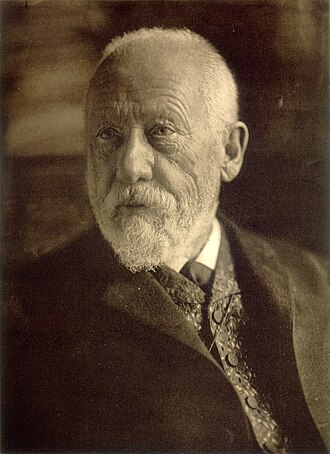
Wilhelm Dilthey was born in Biebrich am Rhein (present-day Wiesbaden, Germany) on 19 November 1833 and died in Seis am Schlern (present-day northern Italy) on 1 October 1911. He held professorships in Basel, Kiel, and from 1882 in Berlin — where he occupied the chair once held by Hegel — and devoted his life to a project that remained unfinished yet profoundly influential: providing the human sciences (Geisteswissenschaften) with their own philosophical foundation, comparable to what Kant had given the natural sciences in the Critique of Pure Reason.
Key Concepts
Human Sciences (Geisteswissenschaften) versus Natural Sciences (Naturwissenschaften): The inaugural distinction of Dilthey’s work. The human sciences — history, philology, linguistics, law, theology, economics, psychology — cannot be reduced to the model of the natural sciences because they have a radically different object: historically situated expressions of human life. Attempting to explain them by natural-scientific methods is a categorical mistake.
Erklären versus Verstehen: The fundamental methodological dichotomy. Erklären (explanation) is the method of the natural sciences: it seeks causes, formulates general laws, and subsumes particular cases under universal regularities. Verstehen (understanding) is the proper method of the human sciences: it seeks to grasp the meaning of human expressions (texts, actions, institutions, works of art) in their historical singularity. One does not explain a symphony as one explains the fall of a body; one understands it.
The triad Erlebnis–Ausdruck–Verstehen (Experience–Expression–Understanding): Dilthey’s mature hermeneutic model. Erlebnis (lived experience) is the basic unit of psychic life — not an atomic datum but a meaning-structured totality. Ausdruck (expression) is the objectification of lived experience in external forms — text, gesture, work, institution. Verstehen (understanding) is the movement by which the interpreter reconstructs the lived experience from its expressions. Every human science presupposes this circuit.
Hermeneutic circle (anticipated by Schleiermacher, deepened by Dilthey): Understanding a part of a text requires understanding the whole; understanding the whole requires understanding the parts. This circle is not vicious for Dilthey — it is the structure of historical understanding, which advances spirally, continually revising part and whole in light of each other.
Historicity of human life (Geschichtlichkeit): Human beings are constitutively historical — there is no timeless human nature, but always forms of life situated within specific epochs, cultures, and traditions. The task of the human sciences is precisely to understand this historicity, not to abstract from it.
Types of worldview (Weltanschauungen): In his late writings, Dilthey proposes that the great metaphysical systems and philosophies of history are expressions of basic “types” of orientation toward the world — naturalism, idealism of freedom, objective idealism. No type exhausts the truth; each expresses a dimension of life. This typology anticipates debates about historical relativism, to which Dilthey responds with the idea that philosophy can understand the types without being reduced to any one of them.
Autobiography and hermeneutics of the self: Autobiography is, for Dilthey, the most transparent model of Verstehen — the individual understands their own life by retrospectively narrating its connections of meaning. This theme profoundly influenced Paul Ricoeur.
Influenced by
- Kant — the critical question: what are the conditions of possibility of knowledge in the human sciences?
- Hegel — objective spirit, historicity, cultural achievements as self-objectification of spirit
- Friedrich Schleiermacher — hermeneutics as the art of understanding; hermeneutic circle
- Johann Gustav Droysen — anticipation of the Erklären/Verstehen distinction in the Historik (1858)
- German Historicism (Ranke, Humboldt) — primacy of historical singularity over general laws
Influenced
- Martin Heidegger — Being and Time (1927) radicalizes hermeneutics and historicity, explicitly acknowledging debt to Dilthey
- Hans-Georg Gadamer — Truth and Method (1960) departs from Dilthey in order to overcome psychologism and historicism
- Paul Ricoeur — hermeneutics of narrative and the self; Time and Narrative (1983–1985)
- Max Weber — interpretive sociology (verstehende Soziologie)
- Georg Simmel — philosophy of life and cultural forms
- 20th-century literary studies and historiography — the hermeneutic paradigm in the human sciences
Works
Einleitung in die Geisteswissenschaften (Introduction to the Human Sciences, 1883); Ideen über eine beschreibende und zergliedernde Psychologie (Ideas on a Descriptive and Analytic Psychology, 1894); Das Erlebnis und die Dichtung (Poetry and Experience, 1906); Der Aufbau der geschichtlichen Welt in den Geisteswissenschaften (The Formation of the Historical World in the Human Sciences, 1910); Gesammelte Schriften (Collected Works, 26 vols., begun 1914).
See also
Nineteenth-Century Philosophy; Gadamer; Ricoeur; Schleiermacher; Heidegger
Recommended Books:
 Introduction to the Human Sciences — Wilhelm Dilthey (trans. Ramon J. Betanzos, Princeton UP)
Ver na Amazon →
Introduction to the Human Sciences — Wilhelm Dilthey (trans. Ramon J. Betanzos, Princeton UP)
Ver na Amazon →