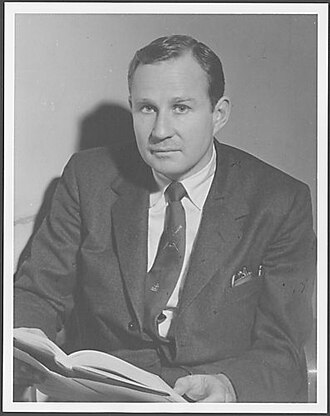
Wilfrid Sellars was one of the most profound and original American analytic philosophers of the twentieth century, though less widely read than his influence would warrant. Trained in a tradition that combined analytic rigor with a deep knowledge of the history of philosophy, he set out to articulate what he called the ultimate aim of philosophy: “to understand how things in the broadest possible sense of the term hang together in the broadest possible sense of the term.” His work seeks to reconcile a commitment to science and naturalism with recognition of the normative dimension of thought and knowledge. He taught above all at the University of Pittsburgh, where he formed an influential line of students.
Key Concepts
The critique of the Myth of the Given (“Empiricism and the Philosophy of Mind,” 1956): in his most celebrated work, Sellars attacks what he calls the Myth of the Given — the idea, central to traditional empiricism, that there is a stratum of immediate, non-inferential, non-conceptual knowledge (sense impressions, sense data) that serves as the ultimate foundation for all other knowledge. Sellars argues that nothing can be at once a purely sensory datum and a justifying reason: for something to justify a belief, it must already have conceptual structure. There is, therefore, no brute, pre-conceptual epistemological foundation.
The logical space of reasons: Sellars distinguishes two kinds of discourse. To characterize a state as knowledge is not merely to describe a psychological or causal fact about the subject, but to place it in the logical space of reasons — in the normative domain of justifying and being able to justify what one asserts. Knowledge belongs to the order of reasons, not merely to the order of causes. This distinction between the normative and the factual became one of Sellars’s most influential legacies.
The manifest and the scientific images (“Philosophy and the Scientific Image of Man,” 1962): Sellars distinguishes two great conceptions of man-in-the-world. The manifest image is the framework of common sense refined by reflection, in which the human being appears primarily as a person, a rational agent embedded in a web of norms and intentions. The scientific image is the framework postulated by the theoretical sciences, populated by particles, fields, and processes. The great philosophical problem, for Sellars, is to articulate a stereoscopic view that reconciles the two images without abusively reducing one to the other — in particular, without losing the normative and personal dimension.
The myth of Jones (in “Empiricism and the Philosophy of Mind”): to give a naturalistic account of the origin of mental concepts, Sellars tells a fable about a “Rylean ancestor” — a community that possesses only a public behavioral vocabulary. A theoretical genius named Jones introduces thoughts and sense impressions as theoretical entities, postulated by analogy with overt speech and with perception, in order to explain intelligent behavior. The moral is that mental concepts do not name immediately accessible private data but have a theoretical, intersubjective character — although, once learned, they can be applied non-inferentially in the first person.
Incipient psychological functionalism: by treating mental states as theoretical posits defined by their role in explaining behavior and in relation to stimuli and responses, Sellars anticipates elements of the functionalism that would come to dominate philosophy of mind in the following decades.
Influenced by
- Immanuel Kant — the thesis that all experience is conceptually articulated
- Gilbert Ryle — the critique of Cartesian mentalism
- The tradition of logical empiricism and analytic philosophy of language
- Charles Sanders Peirce and pragmatism, in his conception of science
Influenced
- Richard Rorty — the critique of foundationalist epistemology
- John McDowell and Robert Brandom — the so-called “Pittsburgh Sellarsians”
- The debate over foundationalism, coherentism, and the content of experience
- The development of functionalism in philosophy of mind
Works
Science, Perception and Reality (1963), a collection that includes “Empiricism and the Philosophy of Mind” (1956) and “Philosophy and the Scientific Image of Man” (1962); Science and Metaphysics: Variations on Kantian Themes (1968); Naturalism and Ontology (1980); the posthumous collection In the Space of Reasons (2007).
See also
W.V.O. Quine Gottlob Frege John Searle