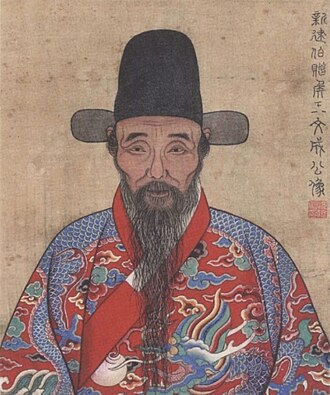
Wang Yangming (王陽明 Wáng Yángmíng, 1472–1529; courtesy name Bó’ān, personal name Shǒurén 守仁) is the most influential Neo-Confucian thinker of the Ming dynasty and the founder of the so-called “school of mind” (xīnxué 心學). Besides being a philosopher, he was a senior state official and a successful military commander, and his doctrine arose in dialogue with that practical experience. His thought constitutes the chief alternative to the Neo-Confucian orthodoxy of Zhu Xi, the “school of principle” (lǐxué 理學), which dominated the imperial examination system.
Against the idea that morality is learned by exhaustively investigating the principle (lǐ) present in external things, Wang holds that the source of moral knowledge lies in the mind itself. His philosophy shifts the axis from bookish study toward interiority and practice, and it had enormous repercussions in China, Korea, and above all Japan.
Key Concepts
The unity of knowledge and action (zhī xíng hé yī 知行合一): Wang’s most famous thesis. Knowing and acting are not two separate moments — one theoretical and the other practical — but a single reality. To know the good truly is, on his view, already to be moved to realize it; one who “knows” but does not act does not, in fact, yet truly know. He thus refuses the dissociation of moral theory from conduct.
Innate moral knowing (liángzhī 良知, “good conscience”): every person possesses in the mind an innate capacity to discern right from wrong, inherited from Mencius’s reflection. This moral consciousness is immediate and universal; ethical work consists in “extending” or fully realizing the liángzhī (zhì liángzhī 致良知), removing the obscurations of selfishness and desire.
Reinterpretation of the “investigation of things” (géwù 格物): Wang reinterprets the classical phrase from the Great Learning that Zhu Xi understood as the exhaustive study of the principles of objects. For Wang, géwù is not external investigation but the rectification (gé) of the mind and the intentions — correcting what is deviant in the heart-mind, rather than accumulating knowledge about the external world.
The mind is principle (xīn jí lǐ 心即理): in direct opposition to Zhu Xi — for whom principle (lǐ) resides in things and must be sought outside — Wang holds that principle is not separate from the mind. There is no lǐ to be discovered in the world independently of the heart-mind that recognizes it; mind and principle are, at bottom, one.
Critique of bookish intellectualism: as a corollary, Wang criticizes the erudition that separates study from the moral life. Excessive reading and the search for external principles can estrange a person from their own moral consciousness; wisdom is not primarily the accumulation of information but the clarity and rectitude of the mind in action.
Influenced by
- Mencius — the notion of liángzhī develops the Mencian thesis of innate moral dispositions
- Lu Xiangshan (Lu Jiuyuan, 12th century) — the precursor of the “school of mind” who had asserted the centrality of the heart-mind
- The Neo-Confucian tradition and the debate with Zhu Xi — his thought is built in explicit criticism of the school of principle (lǐxué)
Influenced
- The later Yangming school — disciples and currents that split into more quietist and more activist branches
- Japanese Neo-Confucianism (Ōyōmei-gaku) — his doctrine was strongly received in Japan and influenced figures associated with reform and political action
- Korean Neo-Confucianism — it entered Korea’s philosophical debates, generally contrasted with Zhu Xi’s orthodoxy
- Modern East Asian moral thought — contemporary readings that prize the unity of theory and practice
Works
The most important work associated with Wang Yangming is the Chuanxilu (傳習錄, “Instructions for Practical Living” or “Record of Instructions for Practice”), a compilation of dialogues, letters, and sayings organized by his disciples — analogous in this respect to the Analects of Confucius, and therefore not a treatise composed continuously by the author himself. Numerous letters and occasional texts also survive, gathered into later collections of his complete works. As with other traditions based on disciples’ records, pinning down the exact formulation of each doctrine must keep in view the editorial mediation of the compilers.
See also
Eastern Philosophy; Mencius; Confucius