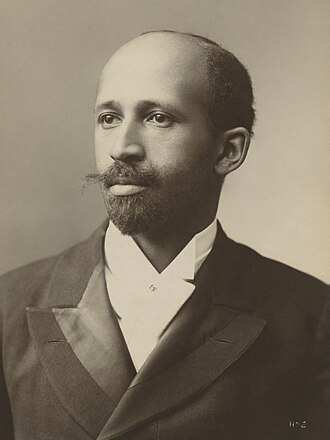
William Edward Burghardt Du Bois (1868–1963) was an African-American sociologist, historian, philosopher, and activist born in Great Barrington, Massachusetts. In 1895 he became the first African American to earn a PhD from Harvard, with a historical dissertation on the suppression of the Atlantic slave trade; he also studied in Berlin, where he absorbed the craft of German social science. His work inaugurated African-American urban sociology with The Philadelphia Negro (1899) and, with The Souls of Black Folk (1903), established a philosophical vocabulary for thinking about modern Black experience. He was a co-founder of the NAACP (1909) and a central figure in pan-Africanism. In 1961 he joined the Communist Party; he then moved to Ghana, where he acquired citizenship and where he died in 1963.
Key Concepts
- Double consciousness (The Souls of Black Folk, 1903): the inner experience of always seeing oneself through the eyes of another, of being torn between being American and being Black, without these identities ever quite being reconciled; a specific form of split produced by modern racism.
- The color line (The Souls of Black Folk, 1903): “the problem of the twentieth century is the problem of the color line” — Du Bois’s thesis is that the racial frontier, and not merely class inequality, structures modern world politics, from the American South to colonial Africa.
- The veil (The Souls of Black Folk, 1903): a metaphor for the social system that separates the white world from the Black world and that grants the African American a “second sight” into the society that excludes him.
- The Talented Tenth (essay of the same title, 1903): the thesis that African-American emancipation would require the formation of an intellectual and moral elite capable of leading the community — a position Du Bois would critically revise in his later decades.
- Reconstruction as an aborted revolution (Black Reconstruction in America, 1935): a monumental rereading of the post-Civil War period as a failed attempt at interracial democracy, sabotaged by an alliance of capital and white supremacy; Du Bois speaks of a “dictatorship of labor” of the freedmen and dismantles the Dunning School historiography.
- Pan-Africanism (Pan-African Congresses, 1919–1945): the political and cultural articulation of the peoples of the African diaspora aimed at decolonisation and the liberation of the continent.
Influenced by
- Hegel — dialectic and “consciousness” as a philosophical term
- William James — psychology at Harvard
- Marx — political economy and class analysis in Black Reconstruction
- Frederick Douglass — the African-American abolitionist tradition
Influenced
- Frantz Fanon — psycho-political analysis of racism
- Cornel West — prophetic pragmatism
- Angela Davis — Black Marxism
- Achille Mbembe — African decolonial thought
- Paul Gilroy — the Black Atlantic
Works
Du Bois’s output spans six decades. The Philadelphia Negro (1899) is one of the first major sociological monographs in the United States. The Souls of Black Folk (1903), a hybrid of essay, autobiography, and history, is his most widely read philosophical text. Black Reconstruction in America (1935) rewrites the history of the post-1865 South. Dusk of Dawn (1940) is an intellectual autobiography subtitled “An Essay Toward an Autobiography of a Race Concept”. To these one may add John Brown (1909), Darkwater (1920), and the late trilogy The Black Flame (1957–1961).
See also
Frantz Fanon, Achille Mbembe, Hannah Arendt