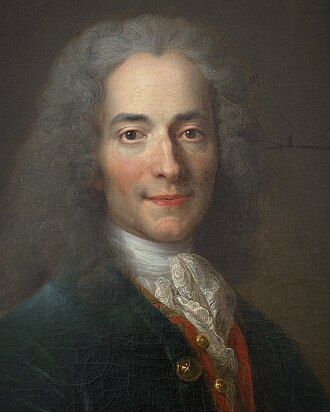
François-Marie Arouet (1694–1778), who would adopt the pen name Voltaire, was the most celebrated and combative figure of the French Enlightenment. Witty and provocative, he was imprisoned in the Bastille and went into exile in England (1726–1728), where he admired political liberty, the empiricism of Locke, and the science of Newton — an experience he would recount in the Philosophical Letters. He frequented the court of Frederick the Great of Prussia and finally settled at Ferney, near the Swiss border, from where he directed public campaigns against injustice. A prolific writer, he left plays, poems, historical works, philosophical tales, and a vast Philosophical Dictionary.
His banner was the struggle against fanaticism and religious intolerance, summed up in the cry “Écrasez l’infâme!” (“Crush the infamy!”). In matters of religion, Voltaire was a deist: he admitted a creator God who ordered the universe like a watchmaker, but rejected dogmas, miracles, and the authority of the Church. His defense of tolerance was not merely theoretical: after the unjust execution of the Protestant Jean Calas, he wrote the Treatise on Tolerance (1763), a landmark in the struggle for individual rights.
His most widely read work, Candide (1759), is a biting satire on the optimism of Leibniz — caricatured in the figure of the tutor Pangloss and his formula “all is well in the best of all possible worlds.” In the face of earthquakes, wars, and cruelties, Voltaire opposes to this abstract optimism a practical, modest wisdom: “il faut cultiver notre jardin” (“we must cultivate our garden”). Unlike Rousseau, he trusted more in gradual reforms and “enlightened despots” than in revolution. He became the foremost symbol of modern secularism and freedom of thought.
Key Concepts
- Critique of fanaticism and superstition: the Church and institutional religion are responsible for most of the violence and injustice in history — “Crush the infamy!” (Écrasez l’infâme!)
- Deism: accepts a watchmaker God who created the universe, but rejects dogmas, miracles, and revelation; natural religion is preferable to revealed religion
- Tolerance: Treatise on Tolerance (1763) — written after the Jean Calas case (Protestant unjustly executed); tolerance is a rational and humanitarian imperative
- Candide (1759): satire on Leibnizian optimism through Pangloss (“all is well in the best of all possible worlds”) — the world is full of evil, injustice, and absurdity; the response is practical action: “il faut cultiver notre jardin”
- Reform through enlightenment: believed that enlightened kings and gradual reforms were the path — not popular revolution (unlike Rousseau)
Influenced by
- Locke — civil liberty and religious tolerance
- Newton — scientific reason and natural order
- Pierre Bayle — skepticism and critique of tradition
Influenced
- Encyclopedists (Diderot, D’Alembert)
- European and American Enlightenment
- Modern secularism and laicism
- Rousseau (ambiguous relationship — philosophical disputes)
Works
Philosophical Letters (1734); Philosophical Dictionary (1764); Candide (1759); Treatise on Tolerance (1763); The Age of Louis XIV (1751).
See also
Contractualism, Enlightenment and Kant