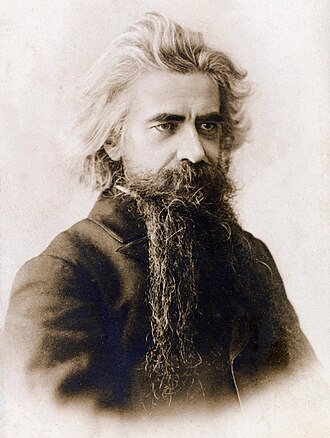
Vladimir Sergeyevich Solovyov (28 January 1853, Moscow — 13 August 1900, the Uzkoye estate near Moscow) was a philosopher, theologian, poet, and critic — the first Russian thinker to build a comprehensive metaphysical system and the founder of the tradition of Russian religious philosophy. The son of the great historian Sergei Solovyov, he was a friend of Dostoevsky and a central figure in the intellectual life of his time. His work cast its shadow over the entire following generation — from Berdyaev and Bulgakov to Russian poetic Symbolism.
Key Concepts
- All-Unity (vseyedinstvo): the fundamental concept of his system. All of reality constitutes an organic whole unified in the Absolute, in which the multiplicity of beings does not oppose unity but realizes it. Against what he saw as the fragmentary and abstract character of modern Western philosophy, Solovyov seeks a living synthesis of being, knowledge, and value.
- Integral knowledge (tselnoye znanie): truth is not reached by isolated reason but by the reunification of reason, experience, and faith (mystical intuition). Empiricism, rationalism, and revelation are partial moments to be integrated — a thesis that critically takes up Kireevsky and the Slavophiles.
- Sophia / Sophiology: Sophia, or Divine Wisdom, is the principle by which the world is unified and contained in God — the “ideal humanity” or world-soul. Solovyov recounted in verse (the poem Three Meetings, 1898) visionary experiences of Sophia; the theme would become central to later Orthodox theology (Florensky, Bulgakov).
- Godmanhood (bogochelovechestvo): universal history is the process of the progressive union of the divine and the human, whose axis is the Incarnation of Christ. Humanity is called to collaborate in this divinization. The theme of the Lectures on Godmanhood (1878–81).
- Free theocracy and ecumenism: for a period Solovyov defended the reunification of the Churches (Orthodox and Catholic) under a universal theocracy harmonizing spiritual authority, temporal power, and prophetic freedom — a project set out in Russia and the Universal Church (1889, written in French).
- Ethics of All-Unity: in The Justification of the Good (1897) he grounds morality in three primary feelings — shame (before lower nature), pity (before others), and reverence (before the higher) — building from them one of the great ethical works of the Russian tradition.
Influenced by
- Platão and Plotino — participation and the One; Neoplatonism
- Schelling and Hegel — the idealism of identity and totality
- Spinoza — the substantial unity of the real (embraced in his youth)
- Kant — critically confronted on the limits of reason
- The Slavophiles (Kireevsky) — “integral knowledge”
Influenced
- Nikolai Berdiáev — the religious philosophy of freedom
- Pavel Florensky and Sergei Bulgakov — Orthodox sophiology
- Semyon Frank — the metaphysics of All-Unity
- The Trubetskoy brothers (Sergei and Yevgeny)
- Russian Symbolism (Alexander Blok, Andrei Bely)
Works
The Crisis of Western Philosophy — Against the Positivists (1874); Lectures on Godmanhood (1878–81); The Critique of Abstract Principles (1880); Russia and the Universal Church (1889); The Meaning of Love (1892–94); The Justification of the Good (1897); Three Conversations on War, Progress, and the End of History, with the “Short Tale of the Antichrist” (1900).
See also
Nikolai Berdiáev, Mikhail Bakhtin