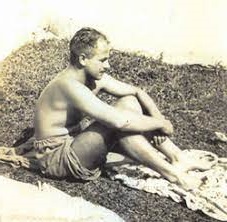
Vicente Ferreira da Silva was born in São Paulo on 10 January 1916 and died in the same city on 19 July 1963, aged 47, in a car accident. He graduated in law from the Largo de São Francisco Faculty of the University of São Paulo but never practiced, devoting himself entirely to philosophy. Although his formal academic life was discreet, he acted as a cultural organizer and was one of the most original Brazilian philosophers of the mid-twentieth century.
Career
His first phase was devoted to logic: Lógica Moderna (1939) and Elementos de Lógica Matemática (1940) are introductory works on modern and mathematical logic. From the 1940s he turned to the philosophy of existence and, progressively, to an ontology of Heideggerian inspiration, with Ensaios Filosóficos (1948), Exegese da Ação (1949), and Dialética das Consciências (1950). In the 1950s his reflection came to center on mythology, the sacred, and the critique of anthropocentric humanism, in works such as Ideias para um Novo Conceito de Homem (1951) and Teologia e Anti-Humanismo (1953).
Institutionally, he founded the Colégio Livre de Estudos Superiores in São Paulo (1945), where he gave free courses; he collaborated with Miguel Reale in creating the Brazilian Institute of Philosophy (1949); and he co-founded, in 1955, the journal Diálogo, together with Dora Ferreira da Silva and Milton Vargas, one of the most stimulating cultural publications of its time.
Key Concepts
- Inversion of the relation between myth and logos — instead of seeing myth as a primitive stage overcome by reason, Vicente Ferreira da Silva conceives philosophy as an unfolding of mythical thought, which remains the originary ground of human experience.
- Critique of anthropocentric humanism — in Teologia e Anti-Humanismo he contests the centrality of the modern human subject and proposes thinking the human from an openness to the sacred and the divine.
- Ontology of the sacred and finitude — the late phase of his work reflects on being, the sacred, finitude, and transcendence, in dialogue with poetry as the foundation of historical meaning.
- Poetic thought — art and poetry are treated as instances that found the historical world, not as cultural ornament.
Influenced by
- Martin Heidegger — the most important influence, especially fundamental ontology and the meditation on being
- Schelling and the Romantic philosophy of mythology
- Jakob Böhme, Novalis, and Hölderlin
- Nietzsche
- Louis Lavelle
- T. S. Eliot
Influenced
- Vilém Flusser, his chief interlocutor and close friend, who called him the first Brazilian philosopher and wrote essays on his work
- The intellectual circle of the journal Diálogo, which he founded in 1955 with Dora Ferreira da Silva and Milton Vargas
- The later reception of Heidegger and of the philosophy of myth in Brazil, revived in editions of his complete works in the early twenty-first century
Works
Lógica Moderna (1939); Elementos de Lógica Matemática (1940); Ensaios Filosóficos (1948); Exegese da Ação (1949); Dialética das Consciências (1950); Ideias para um Novo Conceito de Homem (1951); Teologia e Anti-Humanismo (1953).
See also
Vilém Flusser, Miguel Reale, Gerd Bornheim, Mário Ferreira dos Santos