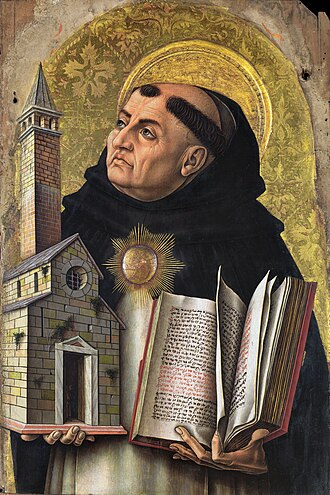
Born around 1225 in Roccasecca, near Aquino, in southern Italy, Thomas belonged to the high nobility, which firmly opposed his entry into the mendicant order of the Dominicans — even confining him for about a year. He studied under Albert the Great in Paris and Cologne and became a master of theology at the University of Paris. Despite the nickname “the dumb ox,” he proved to be the greatest genius of Scholasticism. After an intense experience in 1273, he ceased writing, saying that all he had produced seemed to him like “straw”; he died the following year, on his way to the Council of Lyon. Canonized in 1323, he is “the Angelic Doctor,” and Thomism remains the official reference of Catholic philosophy.
The heart of his work is the reconciliation of faith and reason. Against those who saw an opposition between philosophy (above all that of Aristotle, newly reintroduced into the West by way of the Arabs) and Christian revelation, Thomas holds that both, coming from God, cannot contradict each other: reason prepares and clarifies the path of faith without ever replacing it. He thus achieved the most ambitious synthesis of Aristotelianism and Christianity, set out above all in the monumental Summa Theologiae.
In metaphysics, he distinguishes essence from existence: in all creatures existence is received, whereas in God alone essence and existence coincide — God is the very act of being. To demonstrate God’s existence rationally, he proposes the famous Five Ways (from motion, from efficient causality, from contingency, from degrees of perfection, and from the finality of the world). In ethics and law, he articulates a hierarchy of laws — eternal, natural, human, and divine — in which natural law is the rational creature’s participation in the eternal law. His influence runs through the entire Thomist and neo-Thomist tradition to this day.
Key Concepts
- Being and essence: only in God essence = existence (God is pure actuality); in creatures existence is received by participation
- Five Ways for the existence of God: motion, efficient causality, contingency, degrees of perfection, finalism
- Analogy of being: the concept of being is analogical (neither univocal nor equivocal) — it is said of God and creatures in a proportionally similar manner
- Theory of Law: eternal law → natural law → human law (ius gentium + ius civile) → divine law
- Agent intellect: illuminates intelligible species abstracted from sensible data
- Faith and reason are reconcilable; reason prepares the way for faith
Influenced by
- Aristotle — complete structure of the system
- Augustine — theology, grace
- Avicenna — being and essence
- Averroes — reads and systematically critiques
- Albert the Great (master)
Influenced
- The entire Thomist and neothomist tradition
- Duns Scotus — debate over the univocity of being
- Francisco Suárez — Renaissance scholastic metaphysics
- Christian political philosophy
Works
Summa Theologiae (3 parts); Summa Contra Gentiles; On Being and Essence; commentaries on Aristotle.
See also
Medieval Philosophy