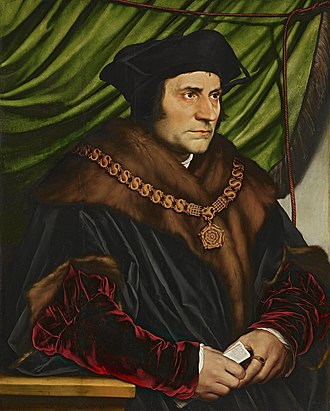
English humanist, jurist, and statesman. Lord Chancellor of Henry VIII; refused to recognize the king as supreme head of the Church and was beheaded. Canonized by the Catholic Church (1935). Author of the concept of utopia.
Thomas More was born in London in 1478, the son of a successful lawyer, and received a rigorous classical education — he studied at Oxford and at the Inns of Court, becoming one of the most respected jurists in Tudor England. His friendship with Erasmus, forged in the early sixteenth century, shaped his intellectual orientation: Christian humanism, which held that society could be reformed through moral renewal and the recovery of good letters, without breaking from the Catholic tradition. Against this backdrop, Utopia (1516) is not merely a literary fantasy but a work of rigorous political philosophy that fuses the Platonic dialogue with Lucianic satire to diagnose the ills of contemporary Europe — land enclosure, noble corruption, dynastic warfare, and the brutality of capital punishment for petty crimes.
More’s method is deliberately ambiguous: by describing a fictional island where private property is abolished, citizens work only six hours a day, and religion is tolerated in many forms, he holds up an unsettling mirror to his own society. The Greek name Utopia — “no place” — signals that the ideal is not an immediate blueprint but a standard of judgment. This tension between the real and the possible made More an indispensable reference in the Western political tradition, influencing utopian socialists of the nineteenth century as well as contemporary debates on distributive justice and religious pluralism. His execution in 1535, refusing to betray his conscience under political pressure, gave his work an ethical dimension that transcends any partisan or confessional allegiance.
Key Concepts
- Utopia (Utopia, 1516): description of an imaginary island with a communal society, without private property, religious tolerance, work for all, equality. The name is a Greek wordplay: ou-topos (no place) / eu-topos (good place)
- Implicit social criticism: Utopia functions as a critical mirror of Tudor England — private property, idle nobility, and the execution of starving thieves are the true absurdity
- Christian humanism: friend of Erasmus (who dedicated Praise of Folly to him); reform of society should come from moral and religious education, not from revolution
- Martyr of conscience: refused to compromise faith for political convenience — “I am the king’s good servant, and God’s first”
Influenced by
- Plato — Republic (ideal city) and dialogues
- Erasmus — Christian humanism and intellectual friendship
- Lucian of Samosata — satirical dialogues
Influenced
- Utopian tradition: Campanella (City of the Sun), Francis Bacon (New Atlantis)
- Political philosophy and 19th-century utopian socialism
- Marx — critique of private property (distant precursor)
- Christian-social political thought
Works
Utopia (1516); History of Richard III (c. 1513); Dialogue of Comfort Against Tribulation (1534, written in the Tower of London).
See also
Humanism and Renaissance