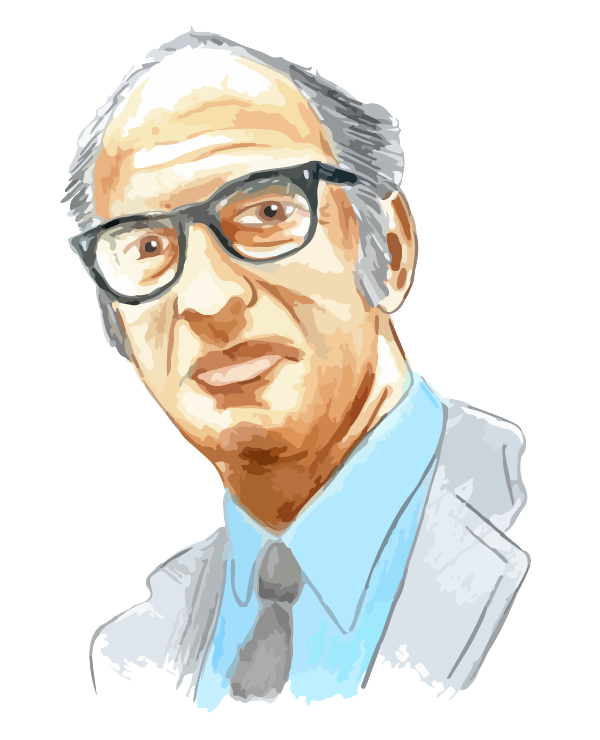
American historian and philosopher of science. The Structure of Scientific Revolutions (1962) completely transformed the understanding of scientific progress and introduced the concept of paradigm into global intellectual vocabulary.
Born in Cincinnati, Ohio in 1922, Kuhn trained as a physicist at Harvard University. While preparing a history of science course for humanities students, he wrestled with Aristotelian theories of motion. The puzzle of why Aristotle — a remarkably acute thinker — had made what seemed like obvious errors from a Newtonian standpoint led Kuhn to realize that the standards of scientific rationality themselves change across historical periods. Rather than asking “who was right?”, he began asking “how does a scientific community come to see the world in a particular way?”. That question shaped all his subsequent work, culminating years later in the book that would redefine how philosophers, historians, and scientists understand science itself.
Kuhn’s central thesis is that science does not advance through a linear accumulation of facts, but through discontinuous ruptures — scientific revolutions — in which an entire constellation of beliefs, values, and techniques is replaced by an incompatible one. This dynamic model challenged the prevailing logical positivism and triggered an intense debate with Popper over the criteria of demarcation and rationality. The concept of incommensurability — the claim that rival paradigms share no neutral language for comparison — proved especially controversial and went on to influence the sociology of scientific knowledge (the Edinburgh School), cultural studies, and even political philosophy. Kuhn taught at MIT from 1979 and retired in 1991 (he died in 1996), leaving a legacy that extends far beyond the philosophy of science.
Key Concepts
- Paradigm: set of theories, methods, exemplary problems and values shared by a scientific community; determines what counts as a legitimate problem and acceptable solution
- Normal science: period of routine “puzzle-solving” work within an established paradigm; does not question its foundations
- Anomaly: experimental or theoretical result that does not fit the paradigm; initially ignored or neutralized
- Crisis: accumulation of resistant anomalies that undermine confidence in the paradigm
- Scientific revolution: replacement of one paradigm by another incompatible with it — not through gradual accumulation, but through conversion of the scientific community; examples: Copernicus, Lavoisier, Einstein
- Incommensurability: rival paradigms are incommensurable — there is no neutral language to compare them directly; scientists live in “different worlds”
- Science as social practice: scientific progress is determined by sociological and historical factors, not merely logical ones — challenge to the rationalist model of Popper
Influenced by
- Karl Popper — philosophy of science (point of debate)
- Alexandre Koyré — history of scientific ideas
- Ludwik Fleck — thought collectives and thought styles (precursor)
- Wittgenstein — language games and forms of life
Influenced
- Popper — Kuhn-Popper debate on scientific rationality
- Paul Feyerabend — epistemological anarchism (Against Method)
- Imre Lakatos — scientific research programs
- Sociology of knowledge (Edinburgh school)
- Humanities in general — “paradigm” became a universal term
Works
The Structure of Scientific Revolutions (1962); The Essential Tension (1977); Black-Body Theory and the Quantum Discontinuity (1978).
See also
Philosophy of the Twentieth Century