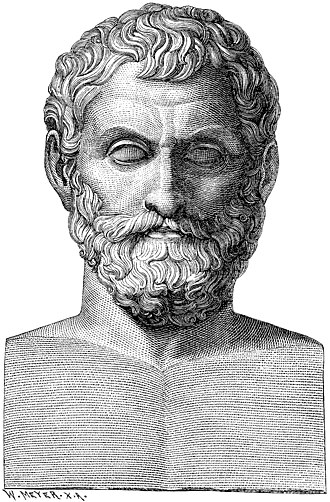
A philosopher from Miletus, in Ionia (in present-day Turkey), who lived around 624–546 BCE, Thales is considered the first philosopher of the Western tradition and was counted among the legendary Seven Sages of Greece. He left no writings; what we know comes from later reports, above all from Aristotle, who hailed him as the founder of this kind of inquiry (Metaphysics I, 3). Many stories gathered around his name: he is said to have predicted a solar eclipse, measured the height of the pyramids by their shadow, and, according to Aristotle, demonstrated the practical value of philosophy by foreseeing a good harvest and cornering the olive-press market.
His importance, however, lies not in the anecdotes but in a decisive change of attitude: the passage from myth to logos. Whereas tradition explained the world through gods and narratives, Thales sought a rational and natural principle (arché) capable of accounting for the totality of things.
This principle, for him, is water — not the water we drink, but the humid, originary element from which everything proceeds and to which everything returns; hence also his thesis that the Earth rests upon water. The choice of a single material principle makes him the first monist, and the question he posed — “what is the fundamental substance of reality?” — became the inaugural problem of philosophy, inherited and transformed by his disciples Anaximander and Anaximenes. To him is also attributed the maxim that “all things are full of gods,” a sign that he conceived nature itself as animate and divine, dispensing with external supernatural explanations. It is also told that, absorbed in observing the stars, he fell into a well — an anecdote Plato records as an image of the philosopher, heedless of practical things but attentive to what is lofty.
Key Concepts
- Arché (principle): water
- Passage from myth to logos
- Material monism
Influenced by
- Oriental cosmologies (Egypt, Babylon)
- Homer and Hesiod (mythology as background)
Influenced
- Anaximander — direct disciple
- Anaximenes — continued the Milesian school
- Aristotle — who cited him as the founder of philosophy
Works
No surviving works. Sources: Aristotle, Metaphysics I, 3; Diogenes Laërtius, Lives, I.
See also
Pre-Socratics and Sophists