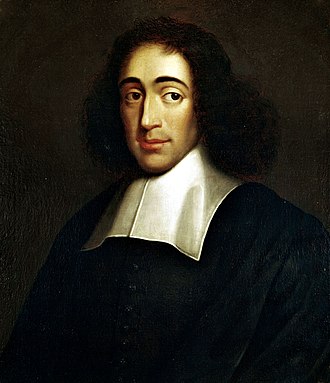
Born in Amsterdam in 1632, into a family of Sephardic Jews of Portuguese origin who had fled the Inquisition, Baruch Spinoza received a rabbinic education, but his ideas soon put him on a collision course with the community: in 1656 he was subjected to a herem (excommunication) of rare severity. He declined chairs and honors to preserve his independence of thought and supported himself humbly by grinding optical lenses. He died young, in 1677, and his principal works — among them the Ethics — were published only after his death. He is regarded as the most radical of the seventeenth-century rationalists.
His philosophy sets out from Descartes but breaks with dualism: there exists a single substance, infinite and necessary, which Spinoza calls Deus sive Natura (“God, that is, Nature”). There is no creator God external to the world — God is reality itself, and everything that exists consists of modes (modifications) of this substance, known to us under two of its infinite attributes: thought and extension. The Ethics is demonstrated more geometrico, like a geometry, chaining theorems from definitions and axioms.
From this monism follows an absolute determinism: everything follows by necessity from the divine nature, and free will is an illusion born of ignorance of causes. True freedom is not to escape necessity but to understand it: to cease being swept along by the passions (external causes) and to act instead through reason. Every being is moved by the conatus, the striving to persevere in its being. The culmination is the intellectual love of God, the knowledge that sees all things sub specie aeternitatis (under the aspect of eternity). His audacity influenced Leibniz, the Enlightenment, modern biblical criticism, and above all Hegel — for whom “to begin with Spinoza is to begin philosophizing.”
Key Concepts
- Monism: there exists a single substance: Deus sive Natura (God or Nature)
- Attributes: the substance has infinite attributes; we know two — thought and extension
- Modes: all individual beings are modes (temporary modifications) of the single substance
- Absolute determinism: everything happens by necessity; there is no real contingency — free will is illusory
- Freedom = knowledge of necessity; to act by internal (adequate) causes rather than be moved by external causes (passions)
- Intellectual love of God (amor intellectualis Dei): the third kind of knowledge — to see all things sub specie aeternitatis
- Conatus: the striving of each thing to persevere in its being — universal law
Influenced by
- Descartes — point of departure and problem (dualism to overcome)
- Giordano Bruno — Deus sive Natura, pantheism
- Medieval Jewish philosophy (Maimonides)
Influenced
- Leibniz — read and discussed with Spinoza
- Hegel — “to begin with Spinoza is to begin philosophizing”
- Schelling — philosophy of identity
- Nietzsche — conatus / will to power
- Marx — immanence, critique of religion
Works
Ethics Demonstrated in Geometric Order (1677, posthumous); Theological-Political Treatise (1670); Treatise on the Improvement of the Intellect.
See also
Rationalism and Empiricism