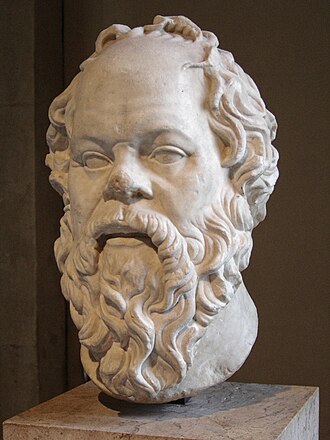
Socrates is the pivot of Greek philosophy: his figure divides the tradition between the pre-Socratics, concerned with the investigation of nature (physis), and the Socratics, who shifted the focus to the human being, the soul, and ethics. An Athenian of the fifth century B.C., son of the sculptor Sophroniscus and the midwife Phaenarete, he lived through the Peloponnesian War — serving as a hoplite at Potidaea, Delium, and Amphipolis — and turned the streets and gymnasia of Athens into the setting for an entirely oral philosophy. He left no writings: everything we know comes from others, above all the dialogues of Plato and the writings of Xenophon, alongside the comic caricature of Aristophanes (The Clouds). The difficulty of separating the historical Socrates from the literary character is what scholars call the “Socratic problem.”
His method had two faces. Irony (eironeia) consisted in feigning ignorance in order to expose the interlocutor’s contradictions through the elenchus, the refutative cross-examination that dismantled ill-founded opinions. Maieutics — the midwife’s art, inherited from his mother — sought to help the interlocutor “give birth” to the truth he already carried within. The goal was not to accumulate information but to reach essential definitions (“what is courage?”, “what is justice?”), against the relativism of the Sophists, from whom Socrates distinguished himself by refusing payment for teaching.
At the heart of his ethics lies moral intellectualism: virtue (aretê) is a form of knowledge, and no one does wrong willingly — evil springs from ignorance. Hence the “care of the soul” as the first task, and the conviction, recorded in the Apology (38a), that “the unexamined life is not worth living.” In 399 B.C., accused by Meletus, Anytus, and Lycon of impiety (not recognizing the city’s gods and introducing new divinities) and of corrupting the youth, he was condemned to death. He refused the escape proposed by Crito and drank the hemlock with serenity, a scene immortalized in the Phaedo — making his own death the final argument of his philosophy.
Key Concepts
- Irony + maieutics as dialogical method
- “Know thyself” (gnôthi seautón)
- “I know that I know nothing” — wisdom as consciousness of ignorance
- Virtue = knowledge; evil is involuntary ignorance
- God = Ordering Intelligence and Providence
Influenced by
- Pythagoras — care of the soul
- Heraclitus — inner logos
- Gorgias / Protagoras (as opponents)
Influenced
- Plato — principal disciple; all of Platonic work is Socratic dialogue
- Aristotle — via Plato
- Diogenes of Sinope — radicalization of Socratic self-sufficiency
- Epicurus — “philosophy as an art of living”
- All the Minor Socratics: Cynics, Cyrenaics, Megarics
Works
None. Sources: Plato (Apology, Crito, Phaedo, Meno, etc.); Xenophon (Memorabilia, Apology).
See also
Socrates, Plato and Aristotle