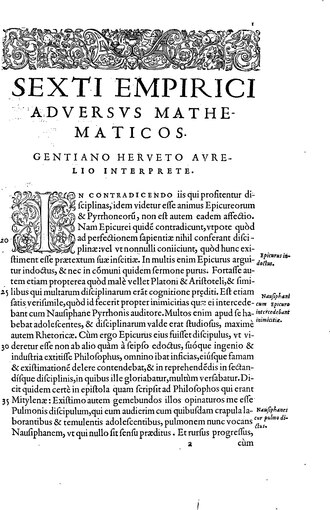
Greek physician and philosopher, the principal systematizer of Pyrrhonian skepticism. His works are the most complete source on the ancient skeptical tradition founded by Pyrrho. While the dogmatists (Stoics, Epicureans, Platonists) claimed to reach definitive truth, Sextus defends the suspension of judgment (epoché) as the path to tranquility (ataraxia). His influence was decisive on modern philosophy, especially on Montaigne, Descartes, and Hume.
Sextus Empiricus probably lived and wrote between the second and third centuries CE, at a time when Pyrrhonian skepticism had been revived by Aenesidemus roughly two centuries after Pyrrho of Elis. The epithet “Empiricus” signals his affiliation with the Empiric school of medicine, which rejected hidden causal theories and confined itself to observable experience — a methodological stance that directly mirrors his philosophy. Although almost nothing is known of his biography, his textual output is exceptional: the Outlines of Pyrrhonism offers a pedagogical presentation of the skeptical method in three books, while the eleven books of Adversus Mathematicos systematically dismantle the knowledge-claims of grammarians, rhetoricians, geometers, arithmeticians, astrologers, musicians, logicians, natural philosophers, and ethicists. This breadth shows that Sextus’s skepticism was not intellectual nihilism, but a rigorous philosophical program: by demonstrating that for every dogmatic assertion there is a counter-argument of equal force (isostheneia), he aims to induce suspension of judgment and, as a consequence, peace of mind.
The historical impact of Sextus Empiricus was discontinuous but profound. His texts remained largely forgotten through the Christian Middle Ages; rediscovered and printed in the sixteenth century, they proved explosive. The Outlines appeared in Latin in 1562, and Montaigne’s Apology for Raymond Sebond (1580) draws extensively on the skeptical tropes. Descartes constructed his method of doubt precisely to neutralize the skeptical challenge Sextus had formulated, and Hume explicitly acknowledged his debt to Pyrrhonism. In the twentieth century, analytic philosophers such as Roderick Chisholm and Richard Popkin reclaimed Sextus as a central interlocutor in debates about foundationalism and the history of skepticism.
Key Concepts
- Epoché (suspension of judgment): faced with equipollent arguments, the skeptic suspends assent — neither affirming nor denying
- Isostheneia (equipollence): equal strength of contrary arguments — for every argument in favor, there is one of equal force against
- Tropes (modes of suspension): systematization of skeptical arguments — 10 tropes of Aenesidemus (relativity of perceptions), 5 tropes of Agrippa (disagreement, infinite regress, relativity, hypothesis, circularity)
- Phenomenon (phainomenon): the skeptic accepts appearances as a practical guide to life, without affirming that they correspond to reality
- Practical criterion: the skeptic lives according to nature, customs, laws, and arts — without claiming absolute truth
- Anti-dogmatism: systematic critique of all philosophical schools that claim to know the ultimate nature of things
Influenced by
- Pyrrho — founder of Pyrrhonian skepticism
- Aenesidemus — renewal of Pyrrhonism; 10 tropes
- Timon of Phlius — disciple of Pyrrho
Influenced
- Montaigne — skepticism of the Essays (Apology for Raymond Sebond)
- Descartes — methodical doubt as a response to skepticism
- Hume — skepticism about causation and induction
- Pascal — limits of human reason
- Francisco Sanches — Quod nihil scitur (1581)
Works
Outlines of Pyrrhonism (Pyrrhōneioi Hypotypōseis, 3 books) — systematic exposition of the skeptical method; Against the Mathematicians (Adversus Mathematicos, 11 books) — refutation of dogmatic disciplines (grammar, rhetoric, geometry, arithmetic, astrology, music, logic, physics, ethics).
See also
Hellenistic Philosophy