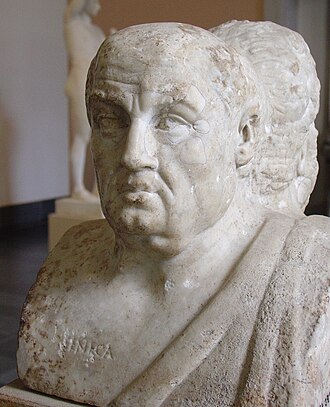
Lucius Annaeus Seneca was born in Corduba, in Hispania, around 4 BCE, the son of Seneca the Elder, a renowned teacher of rhetoric. He was the most influential — and also the most controversial — of the Roman Stoics: a wealthy and powerful senator, he endured exile in Corsica under the emperor Claudius and, on his return to Rome, became tutor and later advisor to the young Nero, whom he sought to restrain in the early years of his reign. Accused of taking part in the Pisonian conspiracy, he was forced by Nero to take his own life in 65 CE — a death that, according to Tacitus’s account, he faced with the serenity his philosophy preached.
Unlike the Greek Stoics, who were also devoted to logic and physics, Seneca concentrates on practical ethics: how to live well in the face of life’s brevity, of unpredictable fortune, and of certain death. In On the Shortness of Life, he argues that life is not short — it is we who squander it, living as though we were immortal. Time is the only good truly ours, and wisdom consists in using it with full awareness. His Letters to Lucilius, a blend of philosophy and spiritual guidance, make writing a daily exercise of self-examination.
At the heart of his doctrine lies self-mastery: the passions (anger, fear, ambition) arise from mistaken judgments and must be disciplined by reason, the only path to tranquillitas animi (tranquility of mind). Death, far from being an evil, is a natural part of the order of the cosmos and even a liberation — and so it should be meditated upon without fear. A cosmopolitan, Seneca saw every human being as a member of a single rational community. His elegant prose influenced early Christianity, the Renaissance humanism of Erasmus and Montaigne, and the long tradition of Stoicism as an art of living — which would culminate, generations later, in the emperor Marcus Aurelius.
Key Concepts
- Stoic carpe diem: time is the most precious good
- Death as liberation and object of constant reflection
- Self-mastery of passions through reason
- Philosophical friendship as the supreme good
- Cosmopolitanism: every human being is part of a universal rational community (echoing Terence’s maxim: “Homo sum; humani nil a me alienum puto”)
Influenced by
- Zeno of Citium and Chrysippus of Soli (Stoic doctrine)
- Epicurus — cites frequently and without sectarianism
Influenced
- Marcus Aurelius — imperial Stoicism
- Renaissance humanism (Erasmus, Montaigne)
- Montaigne — essays as an exercise of self-knowledge
Works
Letters to Lucilius (124 letters); On the Shortness of Life; On the Tranquility of Mind; On Clemency; tragedies (Medea, Phaedra).
See also
Hellenistic Philosophy