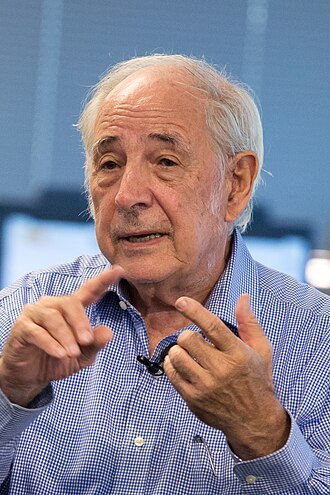
John Rogers Searle, born in Denver (Colorado) in 1932 and died in 2025, was Professor Emeritus at the University of California, Berkeley. His contributions span philosophy of language (speech act theory), philosophy of mind (the Chinese Room argument, biological naturalism), and social ontology (the construction of institutional reality). He is one of the most widely read and debated analytic philosophers of the 20th and early 21st centuries.
Key Concepts
Speech Act Theory (Speech Acts, 1969): Developing J.L. Austin, Searle systematises the theory. Every speech act involves:
- Locutionary act: uttering sounds with sense and reference
- Illocutionary act: what one does in uttering (asserting, promising, ordering, questioning)
- Perlocutionary act: the effect produced in the hearer Searle analyses the felicity conditions of different illocutionary acts and proposes a taxonomy: assertives, directives, commissives, expressives, declarations.
Intentionality (Intentionality, 1983): Mental states have intentionality — they are about something (aboutness). Searle analyses the structure of intentionality: intentional content, conditions of satisfaction, direction of fit (mind-to-world in beliefs; world-to-mind in desires). Explicit influence of Husserl and Brentano, integrated into an analytic framework.
The Chinese Room (“Minds, Brains, and Programs”, Behavioral and Brain Sciences, 1980): A thought experiment against Strong AI (the thesis that an appropriate computer programme is a mind). Imagine a person locked in a room who receives questions in Chinese and has a rule-book for producing correct responses in Chinese — without understanding any of the language. To outside observers, the room “understands Chinese”. But syntax is not sufficient for semantics. Conclusion: no computational simulation of mental processes is genuine cognition, because it lacks real intentionality.
Biological Naturalism: Consciousness and intentionality are biological phenomena — caused by neural processes and realised in the brain. They are not reducible to abstract functional patterns (against functionalism) nor are they immaterial (against dualism). Consciousness is a higher-level property of the nervous system, as liquidity is a higher-level property of H₂O molecules.
The Construction of Social Reality (The Construction of Social Reality, 1995): How do objects such as money, marriages, governments, and borders exist? These institutional facts depend on the collective recognition of a status function: “X counts as Y in context C”. Paper money is paper (X) that, in a social context (C), counts as a medium of exchange (Y). This structure is recursive and self-imposed, but genuinely objective within the institutional framework.
Background: The non-intentional conditions of possibility of intentionality — capacities, skills, habits, and presuppositions that are not themselves intentional states but enable the functioning of intentional states. A concept that engages with Heidegger and Wittgenstein.
Influenced by
- Wittgenstein — use of language, language games, Philosophical Investigations
- J.L. Austin — speech act theory (How to Do Things with Words)
- Husserl — intentionality, phenomenology of consciousness
- Franz Brentano — intentionality as the mark of the mental
Influenced
- Speech act theory (Kent Bach, Robert Harnish)
- Philosophy of mind: debates on AI, consciousness, and intentionality
- Social ontology and theory of institutions
- Linguistic pragmatics
Works
Speech Acts (1969); Expression and Meaning (1979); “Minds, Brains and Programs” (article, 1980); Intentionality (1983); Minds, Brains and Science (1984); The Rediscovery of the Mind (1992); The Construction of Social Reality (1995); The Mystery of Consciousness (1997); Rationality in Action (2001); Freedom and Neurobiology (2007); Making the Social World (2010); Seeing Things as They Are (2015).
See also
Analytic Philosophy Philosophy of Mind
Recommended books:
 Speech Acts — John Searle
Ver na Amazon →
Speech Acts — John Searle
Ver na Amazon →
 The Construction of Social Reality — John Searle
Ver na Amazon →
The Construction of Social Reality — John Searle
Ver na Amazon →