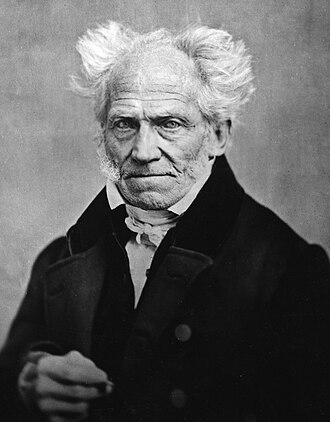
Born in Danzig in 1788, into a wealthy merchant family, Arthur Schopenhauer was able to devote himself to philosophy with financial independence. He earned his doctorate with On the Fourfold Root of the Principle of Sufficient Reason (1813) and at thirty published his major work, The World as Will and Representation (1818) — which, however, was almost entirely ignored for decades. Hostile to the then-dominant Hegel, he even scheduled his lectures at the same hour as his rival’s in Berlin, to no audience. Recognition came only at the end of his life, in the 1850s. He was also the first major Western philosopher to engage seriously with Indian thought (the Upanishads and Buddhism).
Setting out from Kant, Schopenhauer holds that the world has two faces. As representation, it is a phenomenon constructed by the subject — the “veil of Maya,” appearance. But the thing-in-itself, which Kant had judged unknowable, can be sensed from within, in our own body: it is the Will (Wille), a blind, irrational, purposeless striving that constitutes the essence of all that exists.
From this metaphysics springs his famous pessimism. Because the Will is perpetual, insatiable desire, life oscillates between the suffering of lack and the boredom of momentary satisfaction. There are, however, paths of relief: aesthetic contemplation — above all music, the direct expression of the Will — which temporarily suspends willing; compassion (Mitleid), the recognition of another’s suffering as one’s own and the foundation of morality; and, finally, asceticism, the denial of the will-to-live itself. His influence was immense on Nietzsche (in his early period), on Wagner, on Freud and psychoanalysis, and on Wittgenstein.
Key Concepts
- World as representation: phenomenal reality is the “veil of Maya” — construction of the subject
- World as Will: the thing-in-itself is the Will — irrational, blind, eternally unsatisfied
- Pessimism: life is suffering — the Will never satisfies itself; satisfaction → boredom → new desire
- Three paths to liberation:
- Art: aesthetic contemplation temporarily suspends the Will
- Compassion (Mitleid): feeling another’s suffering as one’s own — foundation of morality
- Asceticism: denial of the Will-to-live — permanent path; Buddhism/Hinduism
- Music is the Will directly expressed (not representation)
Influenced by
- Kant — thing-in-itself; a priori forms
- Indian philosophy (Upanishads, Buddhism)
- Plato — the Forms in aesthetic contemplation
Influenced
- Nietzsche (early period; later radical break)
- Wagner — aesthetics
- Freud — death drive (Todestrieb)
- Wittgenstein — silence about the ineffable
- Movement of Buddhist philosophy in the West
Works
The World as Will and Representation (1818/1844, 2 vols.); On the Basis of Morality (1840); Parerga and Paralipomena (1851).
See also
Nineteenth Century Philosophy