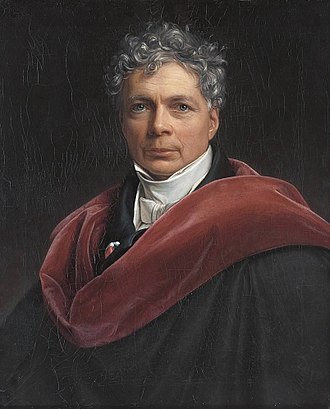
The most versatile of the German idealists; his thought passed through multiple radically distinct phases. He directly influenced Romanticism and anticipated Existentialism.
Born in Leonberg, Württemberg, in 1775, Schelling studied at the Tübingen Stift alongside Hegel and Hölderlin, where enthusiasm for the French Revolution and Kantian philosophy shaped an entire generation. By his early twenties he was already publishing works of remarkable originality, and in 1798 he accepted a professorship in Jena — then the intellectual epicenter of German Idealism and Romanticism. That milieu made him a direct interlocutor of Fichte, Goethe, and the Schlegel brothers, cementing his reputation as the most promising philosopher of his age.
The central problem running through every phase of Schelling’s work is the relationship between the finite and the infinite, between nature and spirit. In his Philosophy of Nature, he rejected Cartesian dualism and argued that nature is not inert matter but spirit in a state of slumber — an unconscious intelligence expressing itself in polar forces such as magnetism, electricity, and living organisms. This vision inspired Romantic poets and naturalists alike and constituted one of the first philosophical attempts to integrate the natural sciences into a coherent speculative whole. In his mature work, especially the Philosophical Investigations into the Essence of Human Freedom (1809), Schelling turned to the problem of evil: if the Absolute is one and good, how can evil and genuine human freedom exist? His answer — that within God himself there is a “dark ground” prior to reason — anticipated themes that Kierkegaard, Heidegger, and twentieth-century existentialists would later take up.
Phases of thought
| Phase | Central theme |
|---|---|
| Philosophy of Nature (~1797) | Nature as visible Spirit, living organism |
| Philosophy of Identity (~1801) | Absolute = undifferentiated identity of subject and object |
| Philosophy of Freedom (1809) | Evil has positive reality; freedom as abyss |
| Positive Philosophy (late) | Concrete existence irreducible; critique of rationalism |
Key concepts
- Nature as objectified Spirit: the same activity of the subject, but in unconscious degree
- Absolute: undifferentiated identity of ideal and real, subject and object — point of indifference
- Evil and freedom: evil is perverse use of freedom — man can isolate himself from the whole
- Positive philosophy: concrete existence is prior to any system — anticipates Heidegger and Kierkegaard
Influenced by
- Kant and Fichte — point of departure
- Spinoza — identity of subject/object
- Giordano Bruno — animated nature
- Böhme — evil and freedom
Influenced
- Hegel — dialectic of identity/difference
- German Romanticism (Schlegel, Novalis)
- Nietzsche — creative will
- Heidegger — concrete existence and finitude
Works
System of Transcendental Idealism (1800); Philosophical Investigations into the Essence of Human Freedom (1809).
See also
German Idealism