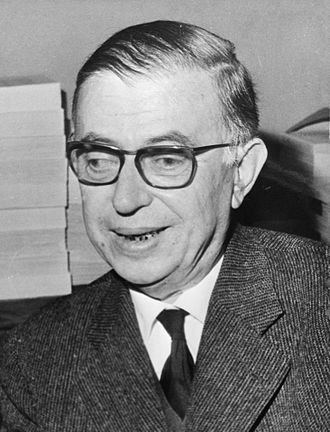
Philosopher, novelist, and playwright, Jean-Paul Sartre was born in Paris in 1905 and trained at the École Normale Supérieure, where he met Simone de Beauvoir, his lifelong intellectual and romantic companion. A stay in Berlin in the 1930s brought him into direct contact with the phenomenology of Husserl and Heidegger, which would become the foundation of his thought. A prisoner of war in 1940–41 and later a central figure of postwar Parisian intellectual life, he made philosophy a public and engaged activity: he founded the review Les Temps Modernes, drew close to Marxism, and, faithful to his refusal of institutional honors, declined the Nobel Prize in Literature in 1964. His death, in 1980, brought tens of thousands into the streets of Paris.
His ontology, set out in Being and Nothingness (1943), distinguishes two modes of being: the in-itself (en-soi), massive and self-identical, proper to things; and the for-itself (pour-soi), the mode of being of consciousness, which is pure openness and negation — a “nothingness” at the heart of being. Because consciousness has no fixed nature, the human being is, above all, freedom: hence the formula that sums up existentialism, “existence precedes essence.” There is no human nature given in advance; first we exist and then, through our choices, we define what we are.
This freedom, however, is also a burden: we are “condemned to be free,” wholly responsible for what we make of ourselves, with no alibi in nature, in God, or in the past — an anguish many try to conceal through bad faith (mauvaise foi), pretending to be a determined thing. In relation to others, the other’s gaze turns me into an object, whence the famous line from No Exit: “hell is other people.” In his maturity, Sartre sought to reconcile individual freedom with historical conditioning, bringing existentialism and Marxism together in the Critique of Dialectical Reason (1960). His influence shaped the feminism of Simone de Beauvoir, the anti-colonial critique of Frantz Fanon, and an entire generation of engaged thought.
Key Concepts
- Existence precedes essence: man exists before having a defined nature; he is condemned to create himself
- Radical freedom: we are always responsible; there is no excuse in nature, society or the past
- Bad faith (mauvaise foi): fleeing from freedom by pretending to be determined like a thing
- Being-in-itself (en-soi): the being of things — opaque, identical to itself
- Being-for-itself (pour-soi): the being of consciousness — nothingness (néant) within being; always projecting
- The Other as hell: “L’enfer, c’est les autres” — the gaze of the other objectifies me
- Late phase: synthesis of Marxism and existentialism (Critique of Dialectical Reason)
Influenced by
- Heidegger — being-in-the-world, anguish (transforms into humanistic existentialism)
- Husserl — intentional phenomenology
- Hegel — master-slave dialectic; pour-soi
Influenced
- Simone de Beauvoir — existentialist feminism
- Frantz Fanon — decolonization
- Political thought of the French left
Works
Being and Nothingness (1943); Existentialism is a Humanism (1945); Nausea (novel, 1938); Critique of Dialectical Reason (1960).
See also
Twentieth Century Philosophy