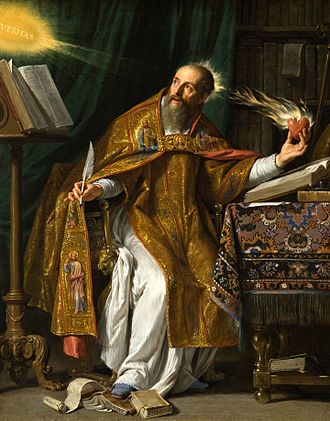
Aurelius Augustine was born in 354 in Thagaste, in Roman North Africa, the son of a Christian mother (Monica) and a pagan father. A teacher of rhetoric in Carthage, Rome, and Milan, he traveled a long intellectual and spiritual road: he was kindled to philosophy by reading Cicero, adhered for years to Manichaeism, passed through skepticism, and found in the Neoplatonism of Plotinus the instrument that would lead him back toward Christianity. His conversion in Milan (386) — the famous “tolle, lege” (“take up and read”) scene narrated in the Confessions — was a turning point. He became bishop of Hippo and, until his death in 430, during the Vandal siege, was the greatest thinker of the Patristic age and one of the most influential figures in the whole history of the West.
His central question is the relation between faith and reason, which he sees as complementary: “believe so that you may understand, understand so that you may believe.” Against the skeptics, Augustine observes that even in doubting there is one unshakable certainty — that I exist: “si fallor, sum” (“if I am deceived, I exist”), a formulation that anticipates Descartes’s cogito by more than a thousand years. Knowledge of truth, however, comes not from Platonic recollection but from a divine illumination working within the soul.
From his meditation on interiority arise his most original analyses: time, which exists not in things but in the soul, as memory (past), attention (present), and expectation (future); evil, which is not a substance but a privation of the good and a turning of the will; and the tension between the earthly city (founded on love of self) and the City of God (founded on love of God), the theme of his political and theological masterpiece. His doctrine of grace, developed in the controversy against the Pelagians, shaped all of Western theology and influenced figures from Thomas Aquinas to Descartes, Pascal, and Kierkegaard.
Key Concepts
- Faith and reason: “Credo ut intelligam, intellige ut credas” — reconcilable and mutually necessary
- Illumination: God illuminates reason from within (vs. Platonic reminiscence)
- Augustinian cogito: “Si fallor, sum” — if I am deceived, I exist (anticipates Descartes)
- Creation ex nihilo: God creates all things from nothing, together with time
- Time: exists in the soul — memory (past), intuition (present), expectation (future)
- Evil: metaphysical (privation of being) / moral (evil will) / physical (consequence of original sin)
- Two Cities: the earthly city (love of self) vs. City of God (love of God)
- Grace: necessary after original sin; the will alone cannot achieve the good
Influenced by
- Plotinus and Porphyry (Neoplatonism)
- Plato (via Cicero and the Neoplatonists)
- Paul of Tarsus and John the Evangelist
Influenced
- All Western Scholasticism
- Anselm of Canterbury — fides quaerens intellectum
- Bonaventure — Franciscan Augustinianism
- Descartes — cogito; interiority
- Pascal — heart vs. reason
- Kierkegaard — individuality and faith
Works
Confessions; The City of God; On Free Choice of the Will; On the Trinity; Against the Academics.
See also
Medieval Philosophy