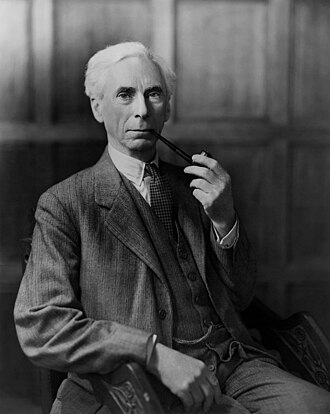
Born in 1872 into an influential British aristocratic family — he was the grandson of a prime minister — Bertrand Russell had one of the longest and most varied careers in philosophy: he was a logician, mathematician, essayist, educator, and political activist, spanning nearly a century of history. He studied at Cambridge, received the Nobel Prize in Literature in 1950, and, faithful to his pacifism, was imprisoned during the First World War and led, in his nineties, the campaign against nuclear weapons (the Russell-Einstein Manifesto, 1955). He is, with Frege and Wittgenstein, one of the founders of analytic philosophy.
In logic and mathematics, his ambition was logicism: to show, in the monumental Principia Mathematica (written with Whitehead), that all of mathematics can be derived from purely logical principles. It was also he who discovered the famous Russell’s paradox — concerning “the set of all sets that are not members of themselves” — which shook the foundations proposed by Frege and required a reconstruction of set theory.
His most influential contribution to the philosophy of language is the theory of definite descriptions (1905): analyzing phrases such as “the present King of France is bald,” Russell showed that the grammatical form of a sentence can conceal its true logical structure — and that many philosophical problems are, in fact, confusions of language to be dissolved by analysis. A champion of rigorous empiricism and of moderate skepticism, he opposed idealism and decisively influenced Wittgenstein, the Vienna Circle, and the whole subsequent analytic tradition.
Key Concepts
- Logicism: mathematics can be completely derived from pure logic — demonstrated (with Whitehead) in Principia Mathematica
- Logical atomism: reality is composed of independent “atomic facts”; elementary propositions correspond to simple facts; the world has the same logical structure as ideal language
- Theory of definite descriptions (1905): “The present King of France is bald” — phrases with descriptions of non-existent entities are neither true nor false; logical analysis dissolves pseudo-problems
- Russell’s Paradox: the set of all sets that are not members of themselves — leads to contradiction; shook the foundations of Frege’s mathematics and motivated the theory of types
- Knowledge by acquaintance vs. knowledge by description: we directly know sense data and mental states; everything else we know indirectly through descriptions
- Moderate epistemological skepticism: defended that knowledge of the external world is probable inference, not certainty; opposed the idealism of Berkeley
- Public philosophy: pacifism in the First World War (was imprisoned), opposition to Stalinism, Russell-Einstein Manifesto (1955) against nuclear weapons
Influenced by
- Frege — predicate logic (starting point)
- Leibniz — logic and rationalist optimism
- Hume — empiricism and skepticism
Influenced
- Wittgenstein — direct disciple at Cambridge; the Tractatus is a response to Russell
- Vienna Circle — logical positivism
- Analytic philosophy in general (Quine, Strawson, Dummett)
- Contemporary mathematical logic
Works
The Principles of Mathematics (1903); On Denoting (1905); Principia Mathematica (1910–13, with Whitehead); The Problems of Philosophy (1912); Our Knowledge of the External World (1914); A History of Western Philosophy (1945).
See also
Twentieth-Century Philosophy