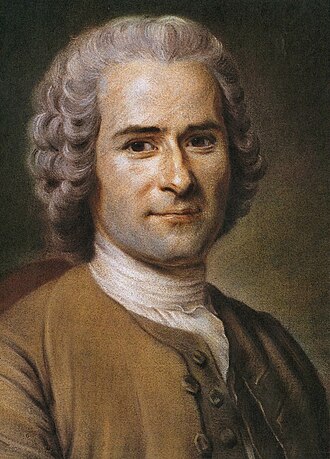
Born in Geneva in 1712 and motherless from birth, Jean-Jacques Rousseau was largely self-taught and led a wandering life before rising to prominence in Paris, where he kept company with the Encyclopedists — from whom he would later break dramatically. Recognition came in 1750, when he won the Dijon Academy’s competition with a discourse that already announced his most provocative thesis: that the arts and sciences, far from improving humanity, corrupt morals. Persecuted after the publication of Emile, condemned and forced into exile, he ended his life tormented, in 1778, leaving behind the Confessions. He is the great critic of the Enlightenment from within the Enlightenment itself.
His philosophy begins from a diagnosis: “man is born free, and everywhere he is in chains.” In the state of nature, the human being would be good, free, and moved by compassion; it is social life — and above all the emergence of private property — that introduces inequality, vanity, and servitude, as he argues in the Discourse on the Origin of Inequality (1755).
If there is no return to the state of nature, what remains is to found a just society. This is the proposal of The Social Contract (1762): through the general will (volonté générale) — which is not the sum of particular interests but the expression of the common good — the citizen, in obeying the law he himself helps to make, obeys only himself, attaining civil freedom. In Emile, he formulates a natural education, attentive to the rhythm of the child. A champion of the primacy of feeling and moral conscience, Rousseau directly inspired the French Revolution, the moral autonomy of Kant, and the whole of Romanticism.
Key Concepts
- “Noble savage”: man in the natural state is good and free; society and property corrupt him
- General will (volonté générale): not the sum of individual wills, but the common good; in obeying it, the citizen obeys himself — civil freedom
- Social contract: men create a political association that expresses the general will
- Natural education (Emile): follow the nature of the child; do not impose conventions prematurely
- Critique of progress: the arts and sciences corrupt morals — an Enlightenment paradox
- Primacy of feeling and moral conscience over cold reason
Influenced by
- Locke — natural rights, but reverses the view of property
- Plato — the Republic as political inspiration
Influenced
- Kant — moral autonomy (Rousseau was “the Newton of the moral world” for Kant)
- French Revolution — general will as foundation
- Hegel — will as the foundation of the State
- Romanticism (valorization of nature, feeling, childhood)
- Modern pedagogy
Works
Discourse on the Sciences and the Arts (1750); Discourse on the Origin of Inequality (1755); The Social Contract (1762); Emile, or On Education (1762); Confessions (posthumous).
See also
Contractarianism, Enlightenment and Kant