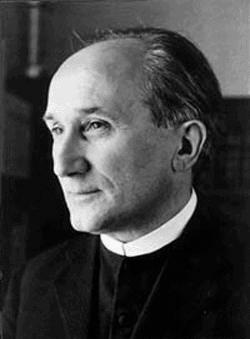
Romano Guardini was born in Verona on 17 February 1885 and died in Munich on 1 October 1968. The son of Italian parents, he grew up in Mainz, Germany, and became a German citizen. He studied chemistry, economics and theology, was ordained a priest in 1910, and obtained his habilitation in 1922 with a work on Bonaventure’s doctrine of redemption. In 1923 he received in Berlin a chair of philosophy of religion and Catholic worldview, which he held until 1939, when the National Socialist regime removed him from teaching. After the war he taught at Tübingen (1945–1948) and, from 1948, at Munich, until 1962. He was also an important figure in the Catholic youth movement, especially at Burg Rothenfels, and in the German liturgical movement.
His thought is directed to the interpretation of Christianity and of modern culture rather than to the construction of a system. He wrote essays on Dante, Pascal, Dostoevsky, Hölderlin and Rilke, drawing on literary and philosophical works to think about Christian existence.
Key Concepts
- Polar opposition (Gegensatz) — in Der Gegensatz. Versuche zu einer Philosophie des Lebendig-Konkreten (1925), he proposes that the living and concrete can be thought only as a tension of opposite poles that are neither reducible to one another nor fused (for example unity and multiplicity, identity and otherness, form and fullness); life would be the maintenance of these contrasts.
- Liturgy as play and form — in Vom Geist der Liturgie (1918), he presents the liturgy as a symbolic action in which the community is formed and the person educated; the work was decisive for the twentieth-century liturgical movement.
- Critique of modernity and power — in Das Ende der Neuzeit (1950) and Die Macht (1951), he interprets the modern age as exhausted and examines the question of technical power, which, in Guardini’s view, demands a new moral responsibility. The former is cited in Pope Francis’s encyclical Laudato si’ (2015).
- Person and world — in Welt und Person (1939), he develops a Christian anthropology in which the person is irreducible both to the world and to God.
- Christology — in Der Herr (1937), meditations on the figure of Christ drawn from the Gospels.
Influenced by
- Bonaventure, the subject of his habilitation
- Saint Augustine and Blaise Pascal, to whom he devoted studies (Christliches Bewußtsein. Versuche über Pascal, 1935)
- Dostoevsky, the subject of Der Mensch und der Glaube (1932)
Influenced
- The liturgical movement and the liturgical reform of the Second Vatican Council
- Twentieth-century German-language Catholic theology and philosophy, with readers such as Joseph Ratzinger, who acknowledged his influence
- Catholic reflection on technology, power and ecology, in the line of Laudato si'
Works
Vom Geist der Liturgie (1918); Vom Sinn der Kirche (1922); Der Gegensatz (1925); Briefe vom Comer See (1927); Der Mensch und der Glaube (1932); Christliches Bewußtsein (1935); Der Herr (1937); Welt und Person (1939); Das Ende der Neuzeit (1950); Die Macht (1951).
See also
Max Scheler, Josef Pieper, Edith Stein, Karl Jaspers, Blaise Pascal