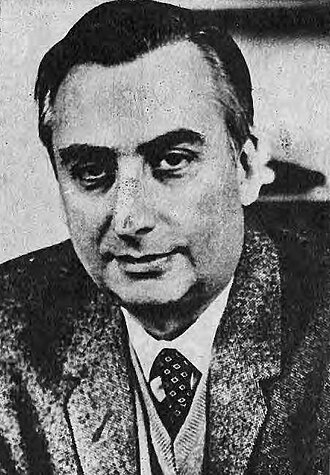
Roland Barthes (12 November 1915, Cherbourg — 26 March 1980, Paris) was a French literary critic, semiologist, and essayist, one of the central figures of structuralism and of the post-structuralist turn. Marked in youth by tuberculosis, which kept him from a regular academic career, he built an unclassifiable body of work poised between criticism, philosophy, and literature. In 1977 he was elected to a chair of literary semiology at the Collège de France. He died in 1980, weeks after being struck by a van in Paris.
His path is usually divided into phases: an early Marxist and Sartrean moment (Writing Degree Zero, 1953); the semiological and structuralist phase (Mythologies, 1957; Elements of Semiology, 1964); and the textualist, post-structuralist turn from S/Z (1970) onward, culminating in the essays on pleasure and the later, more intimate and fragmentary works.
Key Concepts
- Myth as a second-order semiological system (Mythologies, 1957): Barthes applies the sign of Ferdinand de Saussure to mass culture. Myth is a connotation: it takes an already complete sign (a magazine cover, a plate of food) and loads it with an ideological meaning that passes itself off as natural. The function of myth is to turn history into nature — to naturalize what is constructed.
- The death of the author (The Death of the Author, 1967/68): a text’s meaning does not lie in its writer’s intention. “The birth of the reader must be at the cost of the death of the Author.” The text is a tissue of quotations without fixed origin; it is the reader, not the author taken as an explanatory deity, who unifies it.
- Readerly and writerly (lisible / scriptible, in S/Z, 1970): the readerly text is the classic, consumable, closed in meaning; the writerly makes the reader a producer, plural and open. In S/Z, Barthes dissects a Balzac novella into five “codes” that weave the narrative.
- Studium and punctum (Camera Lucida, 1980): in photography, the studium is the coded cultural interest one can comment on; the punctum is the piercing detail that wounds the viewer, escaping the code — the mark of affect and loss.
- Pleasure and bliss of the text (The Pleasure of the Text, 1973): a distinction between pleasure (comfortable, tied to culture) and bliss (jouissance, an enjoyment that shakes the subject and its certainties).
- The reality effect and the critique of doxa: realist literature produces the illusion of reference through “useless” details; and the critic’s task is to denaturalize doxa, the dominant opinion that presents itself as obvious.
Influenced by
- Ferdinand de Saussure — the sign and the semiological project
- Karl Marx and Bertolt Brecht — the critique of ideology (early phase)
- Sartre — the notion of committed writing, later surpassed
- Louis Hjelmslev — the theory of connotation
Influenced
- Contemporary literary theory and narratology
- Post-structuralism and the theory of the text (Jacques Derrida, Julia Kristeva)
- Cultural studies and the critique of mass culture
- Reader-response and the theory of reading
Works
Writing Degree Zero (1953); Mythologies (1957); Elements of Semiology (1964); S/Z (1970); Empire of Signs (1970); The Pleasure of the Text (1973); A Lover’s Discourse: Fragments (1977); Camera Lucida (1980).
See also
Ferdinand de Saussure, Lévi Strauss, Jacques Derrida