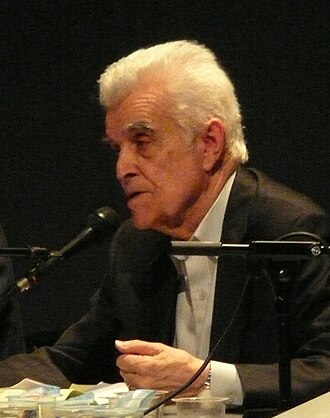
René Girard was born in Avignon, France, on 25 December 1923 and died in Stanford, California, on 4 November 2015. Trained as a paleographer and archivist at the École des Chartes, he moved to the United States in 1947 and earned a doctorate in history from Indiana University in 1950. He taught at Johns Hopkins University, at the State University of New York at Buffalo, and, from 1981, at Stanford, where he remained until his retirement in 1995. He was elected to the Académie française in 2005.
Girard began as a literary critic. In Mensonge romantique et vérité romanesque (1961; Deceit, Desire, and the Novel), he analyzed novels by Cervantes, Stendhal, Flaubert, Proust, and Dostoevsky and proposed that human desire is not spontaneous but imitative: we desire an object because another person, the “mediator” or model, desires it. This triangular structure is the basis of mimetic theory. In La violence et le sacré (1972; Violence and the Sacred), he extended the hypothesis to the anthropology of religion: imitation breeds rivalry, generalized rivalry produces a “mimetic crisis” that threatens the cohesion of the group, and the crisis is resolved by the scapegoat mechanism, in which collective violence is channeled against a victim. According to Girard, sacrificial rituals reproduce this mechanism and myth narrates it from the perspective of the persecutors.
In Des choses cachées depuis la fondation du monde (1978; Things Hidden since the Foundation of the World) and Le Bouc émissaire (1982; The Scapegoat), Girard argued that the biblical narratives, and especially the Passion, reveal the victim’s innocence and unmask the sacrificial mechanism, which gives Christianity a singular role in his reading of culture. This thesis is controversial and has been criticized by anthropologists, who point to the insufficiency of empirical evidence for a universal sacrificial origin of culture, and by theologians and philosophers in debates over his interpretation of Christianity. His last writings, such as Achever Clausewitz (2007; Battling to the End), turned to the escalation of violence in the contemporary world.
Key Concepts
- Mimetic desire — desire is imitative and mediated by a model, not spontaneously generated by the object.
- Mimetic rivalry and mimetic crisis — imitated desires converge on the same objects and generate conflict, which can spread through the whole community.
- The scapegoat mechanism — resolution of the crisis through violent unanimity against a victim, which restores order and sacralizes the event.
- Sacrifice and the sacred — sacrificial ritual repeats the mechanism and contains violence; the sacred is read as transfigured violence.
- Christian revelation of the innocent victim — the thesis that the Gospels dismantle the sacrificial logic.
- Romantic lie and novelistic truth — a contrast between the illusion of the autonomy of desire and the lucidity of the great novelists.
- Escalation to extremes — a reading of Clausewitz as a sign of the mimetic dynamic of modern war.
Influenced by
- Cervantes, Stendhal, Flaubert, Proust, and Dostoevsky — literary readings that grounded the theory of desire
- Sigmund Freud — an interlocutor and target of criticism, especially regarding the Oedipus complex
- Claude Lévi-Strauss and twentieth-century anthropology — the backdrop to his discussion of myth and ritual
- Carl von Clausewitz — the subject of Achever Clausewitz (2007; English Battling to the End)
- The biblical tradition and the Gospels
Influenced
- Jean-Pierre Dupuy — philosophy of risk and catastrophe
- Jean-Michel Oughourlian — mimetic psychology
- Raymund Schwager — dramatic theology
- Eric Gans — generative anthropology
- The Colloquium on Violence and Religion (founded in 1990), which brings together researchers in mimetic theory
Works
Mensonge romantique et vérité romanesque (1961); Dostoïevski: du double à l’unité (1963); La violence et le sacré (1972); Des choses cachées depuis la fondation du monde (1978); Le Bouc émissaire (1982); Je vois Satan tomber comme l’éclair (1999); Achever Clausewitz (2007).
See also
Fyodor Dostoevsky, Sigmund Freud, Claude Lévi-Strauss, Philosophy of Religion