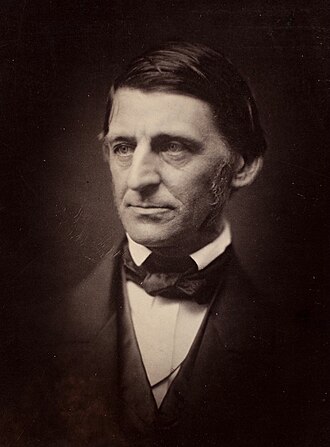
Ralph Waldo Emerson was born in Boston, Massachusetts, on 25 May 1803 and died in Concord, Massachusetts, on 27 April 1882. He studied at Harvard, graduating in 1821, and became a Unitarian minister at the Second Church of Boston. In 1832 he resigned the post over his disagreement with the practice of the Lord’s Supper, and from then on lived as a lecturer and writer, settling in Concord. He became the best-known figure of Transcendentalism, the New England intellectual movement gathered around the Transcendental Club (1836) and the journal The Dial, which included Margaret Fuller, Henry David Thoreau and Bronson Alcott.
His first book, Nature (1836), published anonymously, sets out a vision of nature as a symbol of spirit and contains the famous image of the “transparent eye-ball,” in which the individual, in communion with nature, feels part of a spiritual whole. In The American Scholar (1837), an address delivered to the Phi Beta Kappa Society at Harvard, he argued for American intellectual independence from the European tradition. In the Divinity School Address (1838) he criticized institutional Christianity and attachment to authority, which provoked a strong reaction in Unitarian circles. His mature work lies chiefly in the essays: Essays: First Series (1841), with “Self-Reliance” and “The Over-Soul,” and Essays: Second Series (1844), with “The Poet” and “Experience.”
Key Concepts
- Self-reliance — the essay “Self-Reliance” (1841) asserts the primacy of individual intuition and one’s own judgment over conformity, convention and the authority of institutions and tradition. It is one of the classic formulations of individualism in American culture. Emerson understands trust in oneself as trust in the universal reason that manifests itself in each individual.
- The Over-Soul — the idea of a spiritual unity underlying all individuals and nature, with affinities to Platonism and Neoplatonism.
- Nature as symbol — nature is read as the language of spirit, and poetry as the activity that reveals this correspondence.
- Idealism and Transcendentalism — partly through Coleridge and Carlyle, Emerson received the Kantian distinction between Understanding and Reason and made it the basis of an intuitionist epistemology that contrasts with the Lockean empiricism dominant in New England.
- Scepticism and experience — in “Experience” (1844), written after the death of his son Waldo, Emerson acknowledges the limits of human knowledge and control, qualifying the optimism of his early texts.
Influenced by
- Plato and Neoplatonism — the idea of an underlying spiritual reality
- Immanuel Kant — via Coleridge and Carlyle, the distinction between Understanding and Reason
- Samuel Taylor Coleridge and Thomas Carlyle — mediators of German idealism and Romanticism
- Michel de Montaigne and Goethe — the personal essay and attention to experience and the formation of the individual
- Emanuel Swedenborg and Eastern texts — sources of his symbolism and his image of the divine
Influenced
- Henry David Thoreau — friend and disciple, with whom Emerson shared the Concord circle
- Walt Whitman — acknowledged Emerson as a decisive influence on his poetry
- Friedrich Nietzsche — a reader of Emerson, whose influence on Nietzsche’s work is documented
- William James and John Dewey — the pragmatist tradition acknowledges affinities with his thought
- Stanley Cavell — a contemporary philosopher who wrote extensively on Emerson and took up his work as philosophy
Works
Nature (1836); The American Scholar (1837); Divinity School Address (1838); Essays: First Series (1841); Essays: Second Series (1844); Representative Men (1850); English Traits (1856); The Conduct of Life (1860); Society and Solitude (1870).
See also
Henry David Thoreau, Kant, Plato, Nietzsche, William James, John Dewey