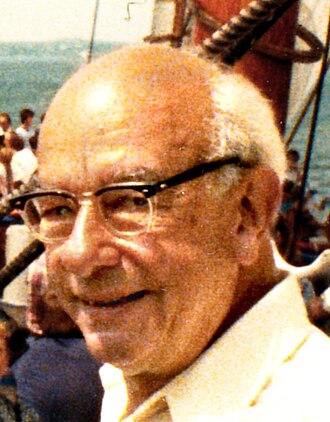
Willard Van Orman Quine was one of the most influential analytic philosophers of the 20th century. A professor at Harvard for decades, his work revolutionised epistemology, philosophy of language, and ontology, while simultaneously dismantling the foundations of the logical positivism of the Vienna Circle. Quine is the principal link between American pragmatism (Dewey, James) and contemporary analytic philosophy.
Key Concepts
Critique of the Analytic/Synthetic Distinction (“Two Dogmas of Empiricism”, 1951, Philosophical Review; reprinted in From a Logical Point of View, 1953): Quine attacks two dogmas of empiricism: (1) the belief in a sharp distinction between analytic propositions (true by meaning, e.g. “all bachelors are unmarried”) and synthetic ones (true by empirical fact); and (2) reductionism (each statement has an isolated empirical content). Quine argues that the notion of “analyticity” is circular — it presupposes “synonymy”, which presupposes “analyticity”.
Epistemic Holism (Duhem-Quine Thesis): Beliefs do not face the tribunal of experience individually, but collectively (web of beliefs). When experience contradicts a belief, we can adjust any part of the system — including logical laws. This view is radically different from the sentence-by-sentence verificationism of positivism.
Indeterminacy of Translation (Word and Object, 1960): The famous “gavagai” example: faced with a native who utters “gavagai” on seeing a rabbit, the radical translator can translate this as “rabbit”, “undetached rabbit part”, or “rabbit instantiation” — all hypotheses are empirically equivalent but mutually incompatible. There is no fact of the matter that determines the correct translation. A radical thesis about the limits of meaning.
Ontological Relativity (“Ontological Relativity”, 1968; in Ontological Relativity and Other Essays, 1969): What exists is relative to the conceptual scheme adopted. Quine’s criterion of ontological commitment: a theory is committed to the existence of X if and only if it must quantify over X to be true — “to be is to be the value of a bound variable”.
Naturalized Epistemology (“Epistemology Naturalized”, in Ontological Relativity, 1969): Traditional epistemology sought a priori foundations for knowledge. Quine proposes abandoning this project: epistemology must be naturalised — become a chapter of psychology and neuroscience, empirically investigating how humans arrive at science from sensory inputs.
Semantic Behaviourism: The meaning of terms must be explained in terms of observable verbal dispositions — without appeal to mysterious mental entities. This position is consistent with Quine’s naturalism but generates tension with the phenomenology of language.
Influenced by
- Russell — mathematical logic and logical analysis
- Carnap and the Vienna Circle — logical positivism (incorporated critically)
- Hume — empirical scepticism and holism
- Dewey and American Pragmatism
- Alfred Tarski — semantic theory of truth
Influenced
- Davidson — semantics and philosophy of mind
- Hilary Putnam — semantic externalism (with critiques of Quine)
- Rorty — naturalism and critique of epistemology
- Philosophy of science and philosophy of biology
- Contemporary theory of language
Works
From a Logical Point of View (1953); Word and Object (1960); Set Theory and Its Logic (1963); The Ways of Paradox (1966); Ontological Relativity and Other Essays (1969); The Web of Belief (with J.S. Ullian, 1970); The Roots of Reference (1974); Theories and Things (1981); The Time of My Life (autobiography, 1985); Pursuit of Truth (1990); From Stimulus to Science (1995).
See also
Analytic Philosophy Rationalism and Empiricism
Recommended books:
 Word and Object — W.V.O. Quine
Ver na Amazon →
Word and Object — W.V.O. Quine
Ver na Amazon →
 From a Logical Point of View — W.V.O. Quine
Ver na Amazon →
From a Logical Point of View — W.V.O. Quine
Ver na Amazon →