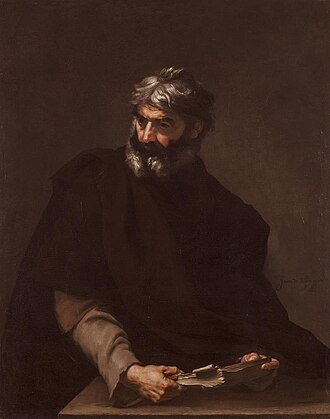
Born in Abdera around 490 BCE, Protagoras was the first and most famous of the Sophists — the itinerant teachers who, for a fee, taught the young the rhetoric and aretê (excellence) needed for success in the public life of the Greek cities. He frequented the circle of Pericles in Athens and even drew up the laws for the colony of Thurii. He is the figure who best embodies the spirit of the sophistic movement.
His most famous thesis is condensed in a single phrase: “man is the measure of all things” (homo mensura) — “of those that are, that they are; of those that are not, that they are not.” With it, Protagoras founds relativism: there is no absolute, single truth valid for all; what appears true to each person is true for that person. The wind that seems cold to me and mild to you is, in fact, cold for me and mild for you.
This relativism extends to religion: concerning the gods, Protagoras professed a frank agnosticism — “I cannot know whether they exist or what their form is; many obstacles prevent this, the obscurity of the matter and the brevity of human life.” Consistent with his practice, he also held that political virtue can be taught — the premise of his profession. Plato, who devoted a dialogue to him, would make the struggle against this relativism one of the engines of his own philosophy; and the homo mensura thesis would resonate, much later, in modern relativism and pragmatism. More than a mere “teacher of eloquence,” Protagoras was one of the first thinkers to reflect systematically on language, education, and the role of convention (nomos) — as opposed to nature (physis) — as the foundation of life in society.
Key concepts
- Homo mensura: relativism of knowledge
- Agnosticism
- Rhetoric as a technique of persuasion
- Political virtue as teachable
Influenced by
- Heraclitus — relativity of perceptions
- Athenian democracy — demand for rhetorical training
Influenced
- Plato — systematic critique of relativism
- Ancient skepticism
- Modern relativism and pragmatism (William James)
Works
On Truth (fragment: the homo mensura thesis); On the Gods (agnosticism). Sources: Plato, Theaetetus, Protagoras; Diogenes Laërtius, Lives, IX.
See also
Pre-Socratics and Sophists