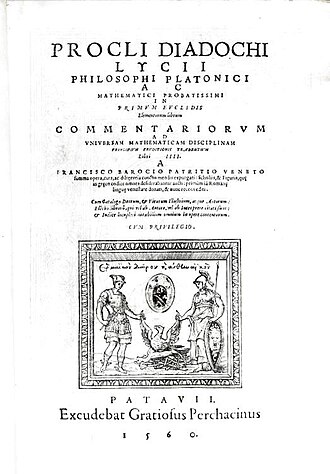
Proclus Lycaeus Diadochus (in Greek Próklos Lýkios Diádokhos, “Proclus the Lycian, the Successor”) was born in Constantinople in 412 CE and died in Athens on 17 April 485 CE. A caveat: he should not be confused with Proclus Procopius (an orator of the 5th century) or other homonymous late-antique figures. The son of a wealthy family from Lycia (in the south of present-day Turkey), he was educated in Alexandria and soon moved to Athens, where he studied with Plutarch of Athens (not to be confused with the essayist of Chaeronea) and with Syrianus, whom he succeeded as head of the Academy — hence his title Diádokhos, “the Successor.” He was the last great systematizer of pagan Neoplatonism before the closure of the Academy by Emperor Justinian in 529 CE. His work organizes the Plotinian inheritance into a rigorous network of propositions and triads, in a project comparable, in ambition, to Aquinas’s Summa — but in an entirely pagan key.
Key Concepts
- The “more geometrico” method (Elements of Theology): 211 propositions demonstrated in a style analogous to Euclid’s Elements, rising from the One to particular beings. It is the prototype of the exposition more geometrico that will resurface in Spinoza.
- Remaining – procession – return (monḗ – próodos – epistrophḗ) (Elements of Theology, props. 25–39): every cause remains in itself, proceeds in its effects, and returns to itself through them. This triad is the key to Proclean emanation and will run through the whole subsequent tradition.
- Henads (henádes) (Elements of Theology, props. 113–165; Platonic Theology): mediators between the absolutely simple One and the multiplicity of beings. The henads are supra-essential unities, often identified with the traditional gods — which allowed Proclus to reconnect Neoplatonic metaphysics with Greek religion.
- Hierarchical triads (Platonic Theology): a refinement of Plotinian emanation into triadic series (limit/unlimited/mixed; being/life/intellect), giving the system a tightly knit combinatorial structure.
- The Platonic commentaries as theology (Commentaries on the Parmenides, Timaeus, Republic, Cratylus, Alcibiades I): Proclus reads Plato as a theologian; the Parmenides in particular is read as a full exposition of the divine hierarchy.
- Theurgy integrated with philosophy (On the Hieratic Art): unlike Porphyry, Proclus accepts the theurgy inherited from Iamblichus as a ritual complement to the philosophical ascent — not replacing contemplation but preparing the soul for it.
- Philosophical hymns (Hymns): poems in hexameter addressed to Helios, Aphrodite, Athena, and other gods, articulating devotion together with metaphysics.
Influenced by
- Syrianus — direct master, the previous head of the Academy
- Plotinus — source of the structure of emanation
- Iamblichus — model for the articulation of philosophy and theurgy
- Plato — canonical source, read as a theologian
- Aristotle — used, cautiously, as propaedeutic
Influenced
- Pseudo-Dionysius the Areopagite (5th/6th century) — incorporates the Proclean structure into Christian theology
- The medieval Latin tradition via the Liber de causis (an Arabic paraphrase of the Elements of Theology), commented on by Thomas Aquinas
- Meister Eckhart — themes of procession and return
- Nicholas of Cusa — coincidence of opposites, reading of the Parmenides
- Hegel — reader of the Commentary on the Parmenides; dialectical structure in triads
- Later Christian, Jewish, and Islamic mysticism
Works
Principal: Stoikheíōsis Theologikḗ (Elements of Theology, 211 propositions), Stoikheíōsis Physikḗ (Elements of Physics), Platonic Theology (in 6 books), Commentaries on Plato’s Parmenides, Timaeus, Republic, Cratylus, and Alcibiades I, Tria opuscula (on providence, fate, and evil), Hymns. Many of the commentaries survive only in fragments or in medieval (Latin and Arabic) translations.
See also
Plotinus; Aristotle; Plato