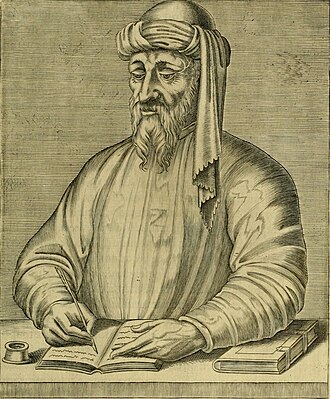
Porphyry of Tyre — in Greek Porphýrios, a name adopted in place of his Semitic birth name Malchus (“king” in Phoenician) — was born around 234 CE in Tyre (on the coast of present-day Lebanon) and died around 305 CE. A caveat: he should not be confused with Porphyry of Gaza (5th century), a Christian bishop with the same name, nor with other late-antique figures bearing it. After studying in Athens with Cassius Longinus, in around 263 CE he joined the circle of Plotinus in Rome, of whom he became the most celebrated pupil. He served as editor of the Enneads (posthumously published c. 301), arranging the master’s writings into six groups of nine treatises and prefacing them with the Vita Plotini (Life of Plotinus) — a fundamental biographical source on Plotinus. His influence, however, reaches far beyond his editorial work: through the Isagoge, Porphyry shaped the entry of Aristotelian logic into the medieval world.
Key Concepts
- The Isagoge and the five predicables (Isagoge, “Introduction”): a brief work conceived as an introduction to Aristotle’s Categories. It defines genus, species, differentia, property, and accident. Translated into Latin by Boethius, it became a mandatory manual of medieval logic.
- The problem of universals (Isagoge, opening lines): Porphyry explicitly formulates three classic questions but refuses to answer them — whether genera and species exist in themselves or only in thought; if they exist, whether they are corporeal or incorporeal; and whether they are separate from sensibles or in them. This praeteritio is the seed of the great medieval dispute between realism and nominalism.
- Contemplative life and ascesis (De abstinentia): a defence of abstaining from meat for ethical, religious, and philosophical reasons; the soul is purified by detaching itself from bodily excess.
- The philosopher’s life as salvation (Sententiae ad intelligibilia ducentes): a collection of aphorisms that condenses Plotinian metaphysics — the soul’s return to the One as a properly philosophical, non-theurgic path.
- Critique of theurgy — disagreement with Iamblichus, his pupil and later rival: Porphyry holds that the soul ascends philosophically as the principal route, whereas Iamblichus introduces theurgic ritual. The Letter to Anebo lays out Porphyry’s objections.
- Anti-Christian polemics (Contra Christianos, 15 books): a systematic attack on Christianity, with historical and philological criticism of the Scriptures. The work was condemned to destruction by Constantine and again by Theodosius II (448 CE), surviving only in fragments quoted by opponents.
- Pythagoreanism and tradition (Vita Pythagorae, De antro nympharum): allegorical reading of Homer and an idealized biography of Pythagoras, situating Neoplatonism within a venerable lineage.
Influenced by
- Plotinus — direct master, whose Enneads he edits
- Longinus — early training in philology and rhetoric in Athens
- Plato and Aristotle — commentary on and harmonization of the two traditions
- Pythagoreanism — the model of the philosopher as spiritual guide
Influenced
- Boethius — Latin translator and commentator of the Isagoge, conduit of ancient logic to the Middle Ages
- The medieval dispute over universals (Abelard, Anselm, Aquinas, Ockham) — all begin from Porphyry’s questions
- Iamblichus (partly in opposition) and the later theurgic tradition
- Christian Patristics (despite Contra Christianos): Augustine and others read his logical and metaphysical writings
- Philosophical vegetarianism in the West
Works
Main writings preserved (in whole or in part): Isagoge (Introduction to Aristotle’s Categories), Vita Plotini (Life of Plotinus, preface to the Enneads), Sententiae ad intelligibilia ducentes (Sentences leading to the intelligible), De abstinentia ab esu animalium (On Abstinence from Animal Food), Vita Pythagorae (Life of Pythagoras), De antro nympharum (On the Cave of the Nymphs), Letter to Marcella. Largely lost: Contra Christianos and numerous commentaries on Plato and Aristotle.
See also
Plotinus; Aristotle; Plato