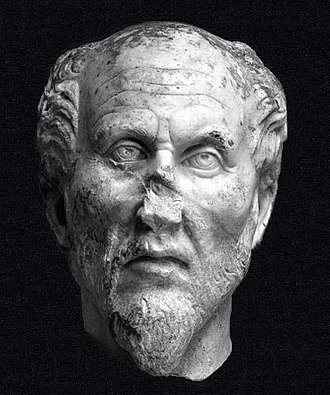
Born around 205 CE, probably in Roman Egypt, Plotinus studied for years in Alexandria under the enigmatic master Ammonius Saccas and later settled in Rome, where he founded a school and led a life of remarkable asceticism. His lessons were gathered and organized by his disciple Porphyry in the Enneads. He is the founder of Neoplatonism and the greatest philosopher of late antiquity, making Plato the starting point of one of the most grandiose metaphysics ever conceived.
At the summit of his system stands the One: the absolute, simple, ineffable principle that lies beyond being and thought themselves. Like an overflowing fountain, the One does not create by will but emanates all of reality from itself, by superabundance. From it proceeds the Nous (Intelligence), which contemplates the Ideas; from the Nous proceeds the Soul, which animates and orders the cosmos; and, at the lower limit of this radiation, lies matter — almost nothing, mere privation and darkness.
But emanation (proodos) has as its counterpart the return (epistrophe): the human soul, exiled in the sensible world, can reascend, step by step, toward its source, up to the mystical union with the One — an ineffable experience that, according to Porphyry, Plotinus himself attained only a few times. In this picture, evil is not a positive force but the mere absence of good. Plotinus’s influence was immense: it shaped Augustine and Christian, Islamic, and Jewish mysticism, and resurfaced in the Renaissance and in the idealism of Schelling.
Structure of reality (emanation)
- The One — absolute, ineffable, beyond being and thought; lacks nothing; emanates by superabundance
- Nous (Intelligence) — first emanation; thinks the Ideas and itself
- World Soul — second emanation; governs the cosmos and contains individual souls
- Matter — limit of emanation; privation, darkness, relative non-being
Key concepts
- Emanation (proodos) and return (epistrophê)
- Mystical ecstasy: ascent of the soul to the One
- Evil as privation, not a real entity
Influenced by
- Plato — Forms, supreme Good, soul
- Aristotle — Nous as Unmoved Mover
- Pythagoras — The One
Influenced
- Porphyry — disciple and editor
- Saint Augustine — illumination, conversion through Neoplatonism
- Nicholas of Cusa — coincidence of opposites
- Schelling — philosophy of identity
- Christian, Islamic, and Jewish mysticism
Works
Enneads (6 groups of 9 treatises, edited by Porphyry) — Portuguese trans. Loyola.
See also
Hellenistic Philosophy