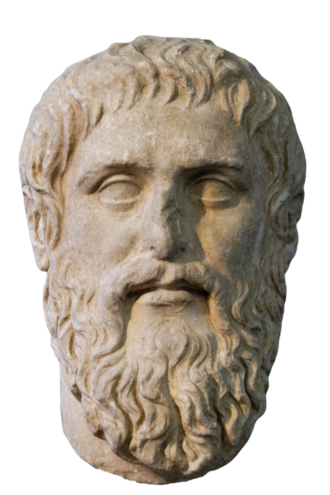
Student of Socrates and the most influential philosopher of antiquity, Plato was born into an aristocratic Athenian family around 428 BCE. His master’s execution in 399 BCE marked him deeply and turned him away from the political career his lineage had reserved for him. After years of travel — which tradition links to contact with the Pythagoreans of southern Italy and to his failed attempts to educate the tyrants of Syracuse — he founded the Academy around 387 BCE, the first institution of higher learning in the West, which would endure for more than nine centuries. His work has reached us almost intact, almost entirely in the form of dialogues, with Socrates as the central character.
The core of his thought is the Theory of Forms (or Ideas): beyond the sensible world — changeable and deceptive — there exists an intelligible world of eternal, immutable essences (Justice itself, Beauty itself, the Good itself), of which concrete things are only imperfect copies that “participate” in them. To know is not to register what the senses show (mere doxa, opinion) but to rise through reason to the Forms (episteme, knowledge). The allegory of the cave (Republic, book VII) dramatizes this ascent: the prisoner who frees himself from the shadows and beholds the Sun — image of the Idea of the Good, source of being and intelligibility.
This metaphysics underpins an ethics and a politics. The human soul is tripartite (rational, spirited, and appetitive), and justice — in the soul as in the city — consists in the harmony of these parts under the rule of reason, whence the thesis of the philosopher-king, who, knowing the Good, ought to govern. In the late dialogues (Parmenides, Sophist, Theaetetus), Plato subjects his own Theory of Forms to rigorous criticism, showing that he never treated it as a closed dogma. His influence runs through the whole history of philosophy — from Aristotle and Plotinus to Augustine and the Renaissance — to the point that Whitehead summed up the European tradition as “a series of footnotes to Plato.”
Key Concepts
- Theory of Forms/Ideas: the real is the eternal intelligible; the sensible is an imperfect copy
- Allegory of the Cave: ascent from the sensible to the intelligible; the Sun = Idea of the Good
- Demiurge: divine craftsman who imposes order on the receptacle according to the Forms
- Tripartite soul: rational / spirited / appetitive
- Philosopher-king: the one who knows the Good must rule
- Eros: desire to reconnect with absolute beauty and goodness
- Recollection (anamnesis): to know is to remember what the soul contemplated before incarnation
Influenced by
- Socrates (teacher)
- Pythagoras — soul/body dualism; mathematics; immortality
- Heraclitus — becoming of the sensible
- Parmenides — immobile being of the Forms
- Orphism — immortality and purification of the soul
Influenced
- Aristotle — student for 20 years; engages critically with Platonism
- Plotinus — Neoplatonism; the One as supreme Good
- Augustine — divine illumination in place of recollection
- Anselm — ontological argument
- Marsilio Ficino — Renaissance Neoplatonism
- Descartes — innate ideas
- Hegel — ascending dialectic
- All of Western metaphysics
Principal Works
Apology, Crito, Phaedo, Meno, Theaetetus, Gorgias, Symposium, Phaedrus, The Republic, Timaeus, Sophist, Parmenides, The Laws.
See also
Socrates, Plato and Aristotle