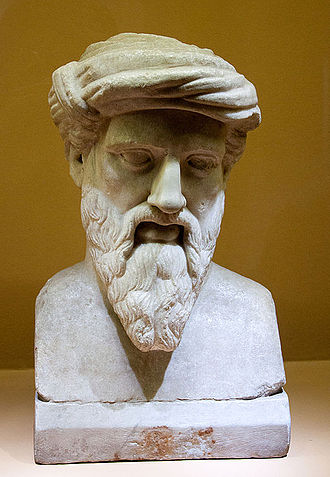
Born on the island of Samos around 570 BCE, Pythagoras emigrated to Croton, in southern Italy (Magna Graecia), where he founded a philosophical-religious community famous for its austere way of life, its rules of silence, and the secrecy of its teachings. Since he wrote nothing and his disciples attributed everything to the master, it is difficult to separate his ideas from those of the Pythagoreans who followed him; already in antiquity his figure blended with legend.
His fundamental intuition is that the principle (arché) of all things is number. The Pythagoreans are said to have discovered that the intervals of musical harmony correspond to simple numerical ratios — an extraordinary revelation: if music, which seemed pure sensation, obeys mathematical proportions, then perhaps the whole cosmos is, at bottom, order and number. Hence the doctrine of the “harmony of the spheres” and the conviction that mathematics is the key to reality.
To this scientific face was joined a mystical one, inherited from Orphism: belief in the immortality and transmigration of the soul (metempsychosis), which would pass from body to body until purified. Philosophy and mathematics were thus paths of purification of the soul. This union of mathematical rigor and spirituality exerted a profound influence on Plato — for whom mathematics prepares the soul for the Ideas — and, centuries later, on Kepler and the idea of a universe written in mathematical language. From the Pythagorean school we also inherit notions as familiar as that of the world as a kosmos — an ordered and beautiful whole — and the very word “philosophy,” which tradition attributes to him.
Key Concepts
- Arché: number (limit + unlimited)
- Metempsychosis / transmigration of the soul
- Purification through mathematics and music
- Harmony of the spheres
Influenced by
- Orphism (transmigration of the soul)
- Anaximander (limit/unlimited)
- Egyptian and Oriental philosophy
Influenced
- Plato — dualism soul/body; mathematics as the path to the Ideas
- Philolaus of Croton — disciple who wrote down the Pythagorean system
- Kepler — mathematical harmony of the cosmos
Works
No direct works. Sources: Iamblichus, Life of Pythagoras; Philolaus, On Nature (fragments); Diogenes Laërtius, Lives, VIII.
See also
Pre-Socratics and Sophists