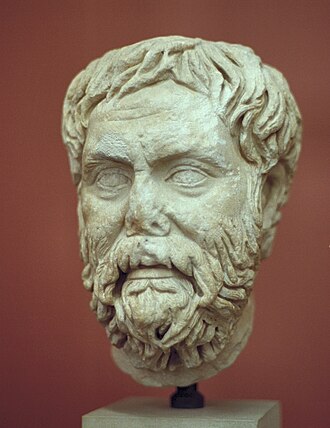
Founder of Ancient Skepticism. Accompanied Alexander the Great to India and encountered ascetics who influenced his thought. Left no writings; lived coherently with epoché. Tranquility (ataraxia) arrives naturally when one suspends all judgment: since we cannot know whether something is good or bad, beautiful or ugly, there is no reason for disturbance.
A native of Elis in the Peloponnese, Pyrrho lived around 365 to 270 B.C. and worked during a period shaped by the dissolution of the classical city-state and the rise of Hellenistic cosmopolitanism. In this context of political instability and cultural diversity, the question of how to achieve happiness (eudaimonia) acquired renewed urgency. Pyrrho’s answer was radical: happiness does not depend on knowing the ultimate truth about things, but on recognizing that such truth is beyond our reach. In his view, things are equally indeterminable, ungraspable, and undecidable (adiaphora, astathmêta, anepíkrita); faced with this situation, the wise course is epoché — suspension of judgment — rather than hasty assertion. His principal disciple, Timon of Phlius, preserved his ideas in verse form, enabling Pyrrhonism to reach later generations.
Pyrrho’s influence extends far beyond Antiquity. The New Academy, especially through Arcesilaus and Carneades, absorbed epoché and turned it into an instrument of philosophical debate. Much later, Sextus Empiricus systematized Pyrrhonism in the Pyrrhonian Outlines, making it the primary reference point for skepticism in Western philosophy. During the Renaissance, Michel de Montaigne revived Pyrrho’s skeptical legacy to challenge the dogmatism of every philosophical school; in the seventeenth century, Descartes employed methodical doubt as the starting point for his rationalist project, engaging — even if critically — with the tradition Pyrrho had inaugurated. By refusing any positive doctrine and proposing philosophical silence as the path to inner peace, Pyrrho founded one of the most enduring and fertile currents in the history of thought.
Key Concepts
- Epoché: suspension of all judgment
- Aphasia: refraining from making assertions about reality
- Ataraxia as a consequence of epoché
- Phenomenalism: only phenomena (appearances) are accessible
Influenced by
- Democritus — relativity of perceptions
- Gorgias — radical skepticism
- Indian ascetics (gymnosophists)
Influenced
- Timon of Phlius — disciple
- New Academy (Arcesilaus, Carneades)
- Sextus Empiricus — systematization of Pyrrhonism
- Montaigne, Descartes (method of doubt)
Works
None. Sources: Diogenes Laërtius, Lives, IX; Sextus Empiricus, Pyrrhonian Outlines.
See also
Hellenistic Philosophy