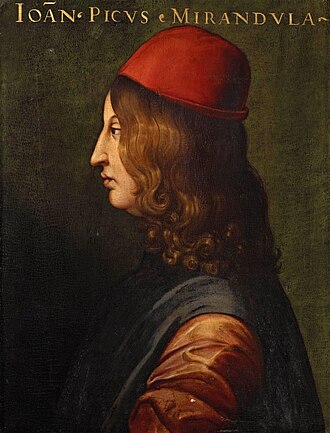
Giovanni Pico della Mirandola. Italian prodigy philosopher; knew Latin, Greek, Hebrew, Arabic, and Aramaic. Proposed to hold a debate in Rome with 900 theses from all philosophical traditions — Pope Innocent VIII condemned some of them. Died at age 31.
Trained at the Platonic Academy of Florence in close dialogue with Marsilio Ficino and within the circle of Lorenzo de’ Medici, Pico represented the apex of Renaissance humanism. In 1486, he composed the 900 Conclusions — theses drawn from sources as diverse as Plato, Aristotle, Avicenna, Averroes, Jewish Kabbalah, and the Corpus Hermeticum — with the ambition of demonstrating that philosophical and religious truth was one, accessible through multiple paths. The project was cut short when a papal commission condemned thirteen of the theses as heretical; Pico fled to France and only returned to Italy under the protection of Lorenzo de’ Medici.
The text later known as the Oration on the Dignity of Man, written as a preface to the planned debate, articulates the central thesis of his philosophy: the human being has no fixed nature like angels or animals, but rather a radical freedom of self-transformation. This argument profoundly influenced modern thinking on autonomy and free will, and his vision of a philosophia perennis — a universal wisdom underlying all traditions — continued to reverberate in Giordano Bruno, the natural philosophers of the sixteenth century, and later in the philosophical ecumenism of modernity.
Key Concepts
- Dignity of Man (Oration on Human Dignity, 1486): man is the only being without a fixed nature — God placed him at the center of the world without determined form so that he might shape himself; it is the highest expression of human freedom and creativity; text considered the “manifesto of the Renaissance”
- Philosophical eclecticism: attempt to synthesize Plato, Aristotle, Jewish Kabbalah, Hermeticism, Christian theology, and Arabic philosophy; truth is one and all traditions participate in it
- Kabbalah: first Christian to use the Kabbalah as a theological argument — sacred letters and numbers confirm Christianity
- Concordism: Plato and Aristotle agree when correctly interpreted (against the Platonic-Aristotelian dispute of the time)
- Magic and astrology: natural magic (mastery of the forces of nature) is the noblest of sciences; distinguishes natural magic from goetia (witchcraft)
Influenced by
- Marsilio Ficino — master and mentor in Florence
- Plato and Aristotle — seeks to reconcile both
- Jewish Kabbalah — Elia del Medigo
- Hermeticism — Corpus Hermeticum
Influenced
- Late Renaissance humanism
- Tradition of philosophia perennis (perennial philosophy)
- Giordano Bruno — philosophical syncretism and magic
- Debate on human dignity in modernity
Works
Oration on Human Dignity (1486); Heptaplus (1489, Kabbalistic interpretation of Genesis); On Being and Unity (1492); 900 Conclusions (1486).
See also
Humanism and Renaissance