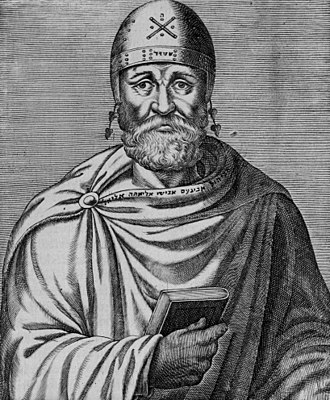
Note on dating: Philo’s dates are not known with precision; his life is estimated between c. 25/15 BCE and c. 45/50 CE, with the firmly dated embassy he led to Caligula in 39/40 CE — recounted in Legatio ad Gaium — serving as the principal point of reference.
Philo of Alexandria — in Latin Philo Iudaeus, “Philo the Jew” — was a Hellenistic Jewish thinker from one of the wealthiest and most influential families of the Jewish diaspora in Alexandria. A Roman citizen, a contemporary of Jesus, Seneca, and the early Julio-Claudian emperors, he wrote entirely in Greek and stood at the crossroads of two traditions: biblical Judaism and Greek philosophy — especially Middle Platonism, Stoicism, and Pythagoreanism. In 38 CE Alexandria was the scene of violent anti-Jewish attacks under the governor Aulus Avillius Flaccus (narrated in In Flaccum), and in 39/40 CE Philo led the delegation of Alexandrian Jews that travelled to Rome to lay their grievances before Caligula. A caveat: Philo is often imprecisely labelled “Neoplatonist.” Strictly speaking, he is pre-Neoplatonist — earlier than Plotinus by more than two centuries — and is best situated within Middle Platonism.
Key Concepts
- Allegorical exegesis (Legum allegoriae, De opificio mundi): beneath its historical letter, the Torah contains a hidden philosophical sense. Patriarchal figures such as Abraham and Moses are read as types of the virtues and of the soul’s ascent to God.
- The transcendent, ineffable God (De opificio mundi §16–25): God is absolutely other, without anthropomorphic attributes; we know that He is, not what He is. This thesis will resonate in the Church Fathers and in negative theology.
- The Logos as mediator (Legum allegoriae III; De opificio mundi): between the transcendent God and the created world, Philo posits the Logos, described as “Firstborn of God,” “Second God,” “image of God,” and instrument of creation. It is not an autonomous hypostasis as in Plotinus, but a mediating principle.
- Creation of the world (De opificio mundi): a reading of Genesis in dialogue with Plato’s Timaeus; God first creates the intelligible world (the model) and then the sensible one (its copy), uniting the Jewish doctrine of creation with Platonic cosmology.
- The contemplative life and the ascent of the soul (De vita contemplativa, De vita Mosis): the virtuous soul passes through stages from sense-perception to the vision of God; Moses is the paradigm of the sage ascending the mountain.
- Natural law and the Decalogue (De decalogo, De specialibus legibus): the Mosaic Law is presented as a particular embodiment of a universal rational law, in line with Stoic thought.
- Providence and evil (Quod Deus immutabilis sit, De providentia): defence of divine immutability and providence, with allegorical readings of biblical passages that seem to attribute passions to God.
Influenced by
- Plato — Timaeus, the doctrine of Forms, intelligible world
- Stoicism — Logos, natural law, providence
- Pythagoreanism — number symbolism, especially of seven
- Aristotle — logical vocabulary, though less central
- Alexandrian rabbinic tradition — exegesis of the Torah in Greek (Septuagint)
Influenced
- Greek Patristics: Clement of Alexandria and Origen openly adopt Philo’s allegorical exegesis
- Latin Patristics: Ambrose and, indirectly, Augustine
- Christian doctrines of the Logos (though the Johannine Logos has its own origin, the conceptual confluence is evident)
- Medieval Kabbalah (structural analogies)
- The history of negative theology and medieval metaphysics
Works
All in Greek, preserved largely thanks to Christian transmission. Principal works: De opificio mundi (On the Creation of the World), Legum allegoriae (Allegorical Interpretation of the Laws), De vita Mosis (Life of Moses), De decalogo (On the Decalogue), De specialibus legibus (On the Special Laws), Quod Deus immutabilis sit (That God Is Unchangeable), De vita contemplativa (On the Contemplative Life, describing the Therapeutae), In Flaccum (Against Flaccus), and Legatio ad Gaium (Embassy to Gaius).
See also
Plato; Plotinus; Aristotle