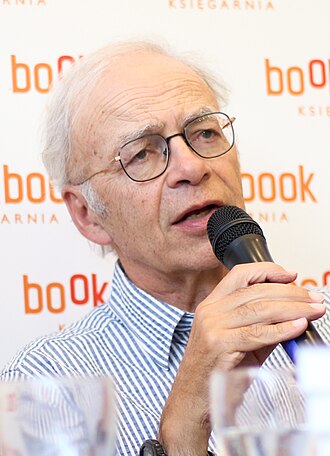
Australian philosopher, professor at Princeton University. He is the most influential living utilitarian philosopher and one of the founders of the contemporary animal rights movement. His book Animal Liberation (1975) introduced the concept of speciesism and transformed the ethical debate on the treatment of animals. He defends a preference utilitarianism (later revised toward hedonistic utilitarianism) and applies moral philosophy to practical issues: global poverty, euthanasia, abortion, the environment, and effective altruism.
Key Concepts
- Speciesism: discrimination based on species, analogous to racism and sexism — privileging human interests over those of other sentient beings without morally relevant justification
- Principle of equal consideration of interests: the interests of all sentient beings (capable of suffering) deserve equal consideration, regardless of species
- Animal liberation: it is not about “rights” in the contractualist sense, but about extending the utilitarian principle of minimizing suffering to all sentient beings
- Ethics of global poverty: if we can prevent suffering without sacrificing anything of comparable moral importance, we ought to do so — omission in the face of extreme poverty is morally equivalent to causing harm
- Effective altruism: a movement that applies evidence and reasoning to determine the most effective ways to improve the world — donations based on measurable impact
- Practical ethics: moral philosophy must confront concrete questions — euthanasia, abortion, genetic engineering, climate change — with rational arguments, not dogma
Influenced by
- Bentham — classical utilitarianism; “the question is not whether they can reason, but whether they can suffer”
- John Stuart Mill — utilitarianism and liberty
- R. M. Hare — universal prescriptivism and preference utilitarianism
- Marx — awareness of structures of oppression (though he rejects Marxism)
Influenced
- Global animal rights movement
- Effective altruism movement (GiveWell, Giving What We Can)
- Contemporary bioethics
- Debate on moral obligations in the face of global poverty
Works
Animal Liberation (1975); Practical Ethics (1979); Rethinking Life and Death (1995); Famine, Affluence, and Morality (1972, article); The Life You Can Save (2009); The Most Good You Can Do (2015).
See also
Twentieth Century Philosophy