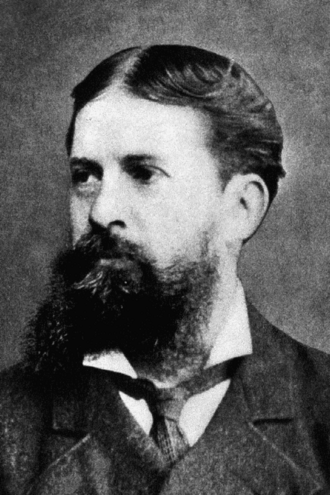
American logician, mathematician, philosopher, and scientist. Founder of pragmatism and modern semiotics. One of the most original minds in the history of philosophy, though neglected in his lifetime. His work profoundly influenced William James, John Dewey, and the entire analytic and continental tradition of the 20th century.
Trained in chemistry at Harvard University and employed for decades by the U.S. Coast and Geodetic Survey, Peirce never secured a permanent academic post — due in part to personal difficulties and to the hostility of influential academic figures such as the astronomer Simon Newcomb; it was William James who, paradoxically, supported him in his years of hardship and became his greatest publicist. This institutional marginality did not prevent him from developing, across hundreds of unpublished manuscripts, a philosophical architecture of extraordinary depth: an original phenomenology, advanced formal logic, a comprehensive theory of signs, and an evolutionary metaphysics.
The central problem driving his entire body of work was the nature of knowledge and rationality. Against Cartesian skepticism, Peirce argued that inquiry does not begin with artificial doubt entertained by a solitary mind, but with genuine doubt arising from experience and resolved over time by the scientific community. This communal and fallibilist vision of reason anticipated contemporary debates on objectivity, consensus, and the social conditions of knowledge.
Key Concepts
- Pragmatism (pragmatic maxim): the meaning of a concept lies in its conceivable practical consequences — “Consider what effects, that might conceivably have practical bearings, we conceive the object of our conception to have”
- Triadic semiotics: every sign involves three elements — sign (representamen), object, and interpretant; signification is always mediated and relational
- Icon, index, and symbol: three types of sign-object relation: resemblance (icon), causal/existential connection (index), arbitrary convention (symbol)
- Fallibilism: no belief is absolutely certain — knowledge is provisional and subject to revision; science advances through self-correction
- Synechism: continuity is a fundamental category of reality — a critique of atomism and nominalism
- Universal categories: Firstness (pure quality, possibility), Secondness (reaction, existence), Thirdness (mediation, law, sign)
- Community of inquirers: truth is the ideal limit toward which the scientific inquiry of an unlimited community of researchers converges
Influenced by
- Kant — categories, transcendental logic
- Aristotle — logic, categories
- Hume and Berkeley — British empiricism (critiqued)
- Charles Darwin — evolutionism applied to thought
Influenced
- William James — popularized pragmatism (modifying Peirce)
- John Dewey — instrumentalism
- Wittgenstein and analytic philosophy — language and use
- Umberto Eco, Roland Barthes — semiotics and text theory
- Habermas — discourse ethics and community of communication
Works
Collected Papers (posthumous, 8 vols.); key articles: “The Fixation of Belief” (1877); “How to Make Our Ideas Clear” (1878).
See also
Twentieth-Century Philosophy