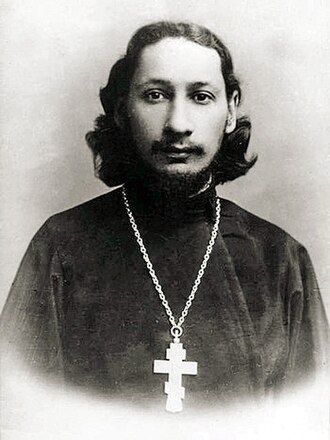
Pavel Alexandrovich Florensky (21 January 1882 [O.S. 9 January], Yevlakh, present-day Azerbaijan — 8 December 1937, executed near Leningrad) was an Orthodox priest, philosopher, mathematician, physicist, and art historian — one of the most wide-ranging intellects in twentieth-century Russia. His contemporaries called him “the Russian Leonardo da Vinci,” an encomiastic phrase that nonetheless accurately signals the breadth of his contributions: he studied theology in Moscow under Sergei Trubetskoy, was ordained a priest in 1911, and simultaneously taught mathematics and philosophy at the country’s leading institutions. After the Revolution of 1917, he continued working in Soviet scientific institutes — refusing to emigrate as many of his contemporaries did — until his first arrest in 1928. Deported to the Gulag, he was shot on 8 December 1937; for decades, the Soviet regime falsified the date of his death, recording it as 1943.
Florensky’s philosophical significance lies in his sustained attempt to unite scientific reason and religious intuition without dissolving either. His method begins from a foundational paradox: truth cannot be grasped by a reason that avoids contradiction, because reality itself, in its fullness, is antinomial. Philosophy, for him, must begin precisely where formal logic breaks down — and it is in that breaking that faith and mystical experience open up. This programme joins, in a singular way, mathematical rigour with the depth of Orthodox theology.
Key Concepts
- Antinomy as the foundation of truth: in The Pillar and Ground of Truth (1914), Florensky argues that religious truth — and, ultimately, all living truth — has an antinomial structure: two mutually contradictory propositions, both equally true. Reason, in pursuing truth to its limit, does not arrive at a Hegelian synthesis but ruptures in contradiction, and it is within that rupture that faith operates as a transforming experience.
- Sophiology: following Vladímir Soloviov, Florensky develops a theology of Sophia (Divine Wisdom) as the mediating principle between God and creation. Sophia is not a fourth divine hypostasis but the aspect by which creation participates in Trinitarian life — an idea that would exert great influence on Sergei Bulgakov.
- Reverse perspective: in his essay Reverse Perspective (written c. 1919–20, published posthumously), Florensky analyses the perspective of Russian-Byzantine medieval icons and argues that the “inverse perspective” — in which objects widen toward the background rather than diminishing — is not technical naivety but a conscious philosophical choice: the icon does not depict the world as seen by a situated subject, but reality radiating toward the observer. This constitutes an implicit critique of Renaissance perspective, which Florensky associates with modern subjectivism.
- Philosophy of the name (Imiaslavie): Florensky participated in the debate over imiaslavie (the glorification of the Name), a monastic movement on Mount Athos that defended the real presence of God in the name “Jesus.” For him, the name is not a mere conventional sign: there is an ontological relation between the name and the named, especially in the case of divine names. This position aligns him with a realist philosophy of language.
- Concreteness and symbol: against the abstractionism of modern philosophy, Florensky proposes a metaphysics of the concrete in which the symbol has genuine ontological value — it does not represent an absent reality but renders it present. The icon, the liturgical rite, and religious language are privileged modes of this concrete symbolism.
Influenced by
- Vladímir Soloviov — Sophiology and the tradition of Russian religious philosophy
- Platão and Plotino — Neoplatonism, participation, and the intelligible
- Georg Cantor’s mathematics — set theory and the paradoxes of the infinite as a horizon for thinking the Absolute
- Patristic theology and the Orthodox hesychast tradition
- The Slavophiles (Kireevsky, Khomyakov) — the critique of Western rationalism
Influenced
- Sergei Bulgakov — Orthodox Sophiology (deeply indebted to Florensky)
- Alexei Losev — the philosophy of the name and twentieth-century Russian metaphysics
- Contemporary scholars of icon aesthetics and religious semiotics
- The philosophical-theological debate on image and representation in the Christian East
Works
The Pillar and Ground of Truth (1914); The Meaning of Idealism (1914); Reverse Perspective (c. 1919–20, published posthumously); Iconostasis (1922, published posthumously); At the Watershed of Thought (lectures, partially published posthumously); Analysis of Spatiality and Time in Artistic and Figurative Works (1924, published posthumously).
See also
Vladímir Soloviov, Nikolai Berdiáev, Mikhail Bakhtin