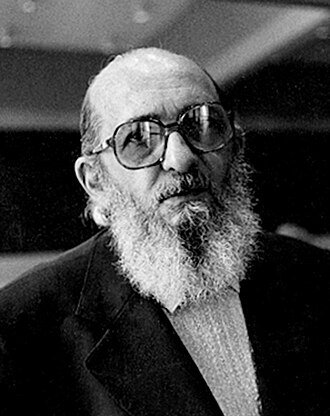
Born in Recife in 1921, amid the poverty of the Brazilian Northeast, Paulo Freire is the most cited and translated Brazilian thinker in the world, and the Patron of Brazilian Education. His philosophy was born of practice: in 1963, in the pioneering Angicos experiment, he taught rural workers to read in a few weeks with a method that joined the reading of the word to the reading of the world. Seen as a threat, he was imprisoned and exiled after the 1964 coup, passing through Bolivia, Chile, the United States, and Switzerland; he would return to Brazil only in 1980. He brought together phenomenology, Marxism, and existentialism in a theory that is at once a pedagogy and a political philosophy of emancipation.
His central critique is directed at “banking education”: the model in which the teacher “deposits” content into a passive student, treated as an empty receptacle. This model, Freire says, is dehumanizing and reproduces oppression, for it denies the learner the status of a subject. To it he opposes problem-posing education, which departs from the concrete reality of learners and is realized through dialogue — the very condition, for Freire, of humanization.
The concept that sums up his project is conscientization: the passage from a naive consciousness, which naturalizes oppression as fate, to a critical consciousness, which perceives the historical causes of inequality and mobilizes to transform them. To educate, therefore, is never neutral: it is a political act, a praxis uniting reflection and action upon the world. His masterpiece, Pedagogy of the Oppressed (1968), became one of the most widely read works in the human sciences, influencing critical pedagogy worldwide, the Philosophy of Liberation of Enrique Dussel, and decolonial studies.
Key Concepts
- Banking education (Pedagogy of the Oppressed, 1968/1970): the dominant model in which the teacher deposits content into a passive student — dehumanizing and reproductive of oppression
- Problem-posing education: departs from the concrete reality of learners; dialogical; transforms consciousness and world
- Conscientization: movement from naive consciousness (naturalizes oppression) to critical consciousness (perceives historical mediations and acts to transform them)
- Generative word: literacy method linking phonetic learning to consciousness of lived reality
- Dialogue: ontological condition of humanization; the denial of dialogue is denial of humanity
- Praxis: indissoluble unity of reflection and action on the world
Influenced by
- Marx — historical materialism and analysis of alienation
- Hegel — master/slave dialectic
- Sartre — existentialism and political commitment
- Frantz Fanon — psychology of colonization
- Husserl and Merleau Ponty — phenomenology of the lifeworld
- Erich Fromm — humanistic psychology
Influenced
- Enrique Dussel and the Philosophy of Liberation
- Critical pedagogy in the United States (Giroux, McLaren)
- Popular education movements in Latin America and Africa
- Decolonial studies
Works
Educação como prática da liberdade (1967); Pedagogy of the Oppressed (1968/1970); Pedagogy of Hope (1992); Pedagogy of Autonomy (1996).
See also
Latin American Philosophy Enrique Dussel