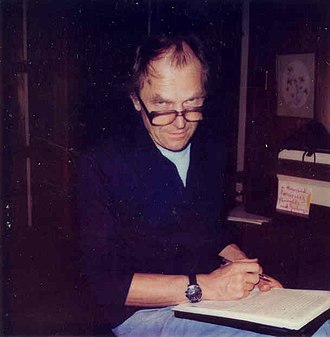
Paul Feyerabend was an Austrian philosopher of science and one of the most provocative thinkers of the twentieth century. Trained in Vienna and based for decades at Berkeley, he began close to logical empiricism and to Popper’s critical rationalism — he even studied under Popper at the London School of Economics — before becoming one of his sharpest critics. His best-known work, Against Method (1975), defends epistemological anarchism: the thesis that there is no single, universal, ahistorical scientific method capable of explaining the success of science. Examining real episodes from the history of science, above all the case of Galileo, Feyerabend argues that progress has often required breaking the methodological rules then in force. His provocation became synonymous with a radical defence of pluralism and intellectual freedom against every dogmatism — including the scientific one.
Key Concepts
- Epistemological anarchism (Against Method, 1975): there is no fixed, universal scientific method; the only “rule” that survives the examination of the history of science is the recognition that every methodological rule has, at some moment of progress, been deliberately violated by scientists.
- “Anything goes” (Against Method, 1975): Feyerabend’s literal slogan, meant ironically — not as a celebration of chaos but as the conclusion that no rigid methodological norm withstands historical scrutiny.
- Principle of proliferation: one should multiply rival theories, even those incompatible with well-established ones, because a multiplicity of alternatives is a condition for the critical advance of knowledge.
- Principle of tenacity: it is rational to retain and develop a theory even in the face of difficulties and anomalies, since abandoning it too soon may stifle its potential.
- Incommensurability: rival theories may share no common measure of comparison — a thesis partly shared with Kuhn.
- Separation of science and state (Science in a Free Society, 1978): a critique of the hegemonic authority of science within institutions; a defence of a pluralism of knowledge traditions in which science enjoys no automatic privilege over other forms of knowing.
Influenced by
- Karl Popper — critical rationalism, his starting point and later his target.
- The Vienna Circle and logical empiricism — his early training, later rejected.
- Ludwig Wittgenstein — his conception of language and “forms of life”.
- John Stuart Mill — defence of freedom of opinion and pluralism (On Liberty).
Influenced
- Contemporary debates on relativism and methodological pluralism in the philosophy of science.
- Social studies of science and the critique of scientism.
- Imre Lakatos — interlocutor and intellectual adversary (they planned a joint book, For and Against Method).
- Movements critical of the exclusive authority of institutionalised science.
Works
His most influential work is Against Method (1975), followed by Science in a Free Society (1978), which deepens the defence of pluralism and of the separation of science and state, and Farewell to Reason (1987). His earlier essays of the 1960s on explanation, reduction, and the problem of incommensurability prepared the ground for these theses.
See also
Karl Popper, Thomas Kuhn, Imre Lakatos