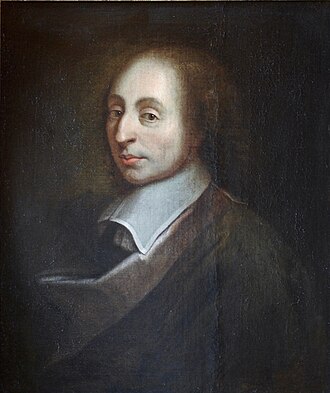
French mathematician, physicist and philosopher. A precocious genius (invented the mechanical calculator at age 19); converted to Jansenism after his “night of fire” (1654). His philosophy is an existential wager and a confrontation with the reason of the libertines.
Key Concepts
- The wager (Pascal’s wager): pragmatic argument about belief in God. If God exists and you believe — infinite gain; if he does not exist and you believe — finite loss. If he exists and you do not believe — infinite loss. Prudent reason bets on God — even without rational proof
- “The heart has its reasons which reason knows nothing of”: there is an order of the heart — intuition, love, feeling — irreducible to the demonstrative logic of Descartes
- Misery and grandeur of man: man is a roseau pensant (thinking reed) — fragile as nature, but his greatness lies in thinking; more noble than the universe because he knows that he dies
- The two infinities: between the great infinity (cosmos) and the small infinity (atom), man stands in the middle — without firm foundation either in sciences or in metaphysics
- Diversion (divertissement): man flees from confrontation with himself through agitation — boredom reveals the human misery that diversion hides. Critique of social superficiality
- Critique of Cartesianism: Descartes’ method is useful in the sciences, but illusory as a foundation for faith or morality; “Descartes useless and uncertain”
- Jansenism: Catholic current that emphasized the irresistible grace of Augustine; Pascal defended Port-Royal in the Provincial Letters against the Jesuits
Influenced by
- Saint Augustine — grace, sin, predestination
- Montaigne — skepticism, human misery (point of departure and adversary)
- Descartes — rationalism (critique)
- Ancient Pyrrhonism — skepticism as apologetic weapon
Influenced
- Kierkegaard — wager, paradox, subjectivity of faith
- Existentialism — anguish and human condition
- Modern Christian apologetics
- Decision theory and game theory (wager as precursor)
Works
Provincial Letters (1656–1657); Pensées (posthumous, 1670 — fragments of an unfinished apologetic); Treatise on the Arithmetic of the Triangle (1654).
See also
Rationalism and Empiricism